
Bryce Canyon in Winter: Snow on the Hoodoos, Silence on the Trails

Bryce Canyon in winter is the version of this park that photographers quietly hope for and most visitors never see. Fresh snow settles on every ledge of the orange hoodoos, the amphitheater turns white and coral under a low sun, and the viewpoints that hold a crowd in July stand empty. The price of all that beauty is real cold. Bryce sits higher than any other park on a Mighty 5 route, and winter here behaves like winter in the mountains, not the desert.
So this guide is built around decisions, not a schedule. What the cold actually feels like, what stays open, what closes, which hikes still work, and how to drive here safely. Get those calls right and winter is arguably the best season to see Bryce. Get them wrong and it is a very cold lesson in altitude.
What Winter Feels Like at 8,000 Feet
The rim at Bryce Canyon runs between about 8,000 and 9,000 feet, and the weather follows the elevation. From December through February, daytime highs hover in the mid to upper 30s Fahrenheit, and overnight lows sit in the mid teens. On the coldest nights the park has dropped far below zero. Even November and March, the shoulder months of the season, only reach the mid 40s on an average afternoon.
Snow is not a possibility here, it is the pattern. Bryce averages roughly 95 inches of snow a year, most of it falling between November and April, and the amphitheater holds its white coat for days after each storm. Add wind along the rim and strong high-altitude sun in a dry sky, and you get the full winter mix in a single day: bitter shade, bright glare, and ice that refreezes every night.
The short days cut both ways. In December the sun sets before 5:30 in the evening, which limits how much you can fit in. But winter sunrise comes late, around 7:30 to 7:50 in the morning in the darkest weeks, so the best light of the day happens at a civilized hour. If you are still weighing winter against the other seasons, our guide to the best time to visit Utah’s national parks compares them side by side.
|
Month |
Typical high |
Typical low |
Normal snow |
What to expect |
|---|---|---|---|---|
|
November |
45°F (7°C) |
23°F (-5°C) |
10 in |
Winter settles in; the in-park lodge closes for the season and crowds vanish |
|
December |
36°F (2°C) |
15°F (-9°C) |
14 in |
Full winter; the shortest days and some of the emptiest viewpoints of the year |
|
January |
37°F (3°C) |
15°F (-9°C) |
17 in |
The coldest month on average; deep snow and total quiet after the holidays |
|
February |
38°F (3°C) |
17°F (-8°C) |
18 in |
The snowiest stretch; Ruby’s Inn hosts its Winter Festival around Presidents Day weekend |
|
March |
45°F (7°C) |
23°F (-5°C) |
17 in |
Still properly snowy, with longer days and storms trading off with bright thaws |
First Decision: What Is Open and What Is Closed
The park itself never closes. Bryce Canyon is open year-round, and the entrance fee is the same $35 per vehicle, good for seven days. What changes in winter is everything seasonal around the edges: services shut down, two trails close outright, and the southern half of the park road depends on the plows.
|
Place or service |
Winter status |
Good to know |
|---|---|---|
|
Visitor center |
Open all winter, 8:00 am to 4:30 pm |
Closed Thanksgiving and Christmas Day; the bookstore sells traction devices |
|
Main road and amphitheater viewpoints |
Open, plowed first after storms |
Sunrise, Sunset, Inspiration, and Bryce Points stay reachable in almost any weather |
|
Southern Scenic Drive to Rainbow Point |
Open between storms |
Closes temporarily after snowfall while plows work; check conditions before driving south |
|
Fairyland Point and Paria View roads |
Closed to vehicles all winter |
The unplowed roads stay open to hikers, skiers, and snowshoers |
|
Park shuttle |
Not running |
The shuttle season runs early April to mid-October, so winter visitors drive themselves |
|
Wall Street side of the Navajo Loop |
Closed all winter |
Hike the Two Bridges side instead |
|
Rim Trail between Inspiration and Bryce Points |
Closed all winter |
The other Rim Trail sections, including Sunset to Sunrise Point, stay open |
|
The Lodge at Bryce Canyon and the general store |
Closed all winter |
Sleep and eat in Bryce Canyon City instead; Ruby’s Inn stays open year-round |
|
Sunset Campground |
Closed in winter |
North Campground Loop A stays open, first come, first served |
The pattern is worth remembering. The amphitheater core, the first three miles of the park, is the priority for the plow crews and stays reachable in nearly all conditions. Everything beyond it is a bonus that depends on the last storm. The park’s own guide to visiting Bryce Canyon in winter and its current conditions page are the two pages to check the night before and the morning of any winter visit.
Hiking Below the Rim: Ice Changes the Math
Winter does not close Bryce’s trails, it changes what they demand. Most day hikes stay open all season, including the descent into the amphitheater. The famous loop simply sheds its famous half: with Wall Street closed, the Navajo Loop becomes a down-and-back on the Two Bridges side, or the top half of the combination with Queen’s Garden. Our Navajo Loop and Queen’s Garden guide covers the route in detail, and winter changes the footing rather than the geography.
The real opponent is ice, and it follows a rhythm. Right after a snowfall, the trails lie deep and soft, and snowshoes are the right tool. A few days of sun and foot traffic pack the snow down, and the popular trails turn into polished ice where snowshoes stop helping. From that point, traction devices that strap over your boots are not optional gear, they are the difference between hiking and skating. The park strongly recommends them for every winter hike, and rangers suggest wearing them even in parking lots.
Buy traction devices at the Bryce Canyon Association bookstore in the visitor center, or rent them in Bryce Canyon City at Ruby’s Inn’s Winter Adventure Center. Then plan around the sun. The amphitheater faces east, so the trails catch morning light and start to soften late in the morning, while shaded switchbacks can stay icy all day. Even in the cold, the dry air dehydrates you quietly, and the layered kit on our Utah national parks packing list earns its place here more than anywhere else on a Mighty 5 trip.


Snowshoes, Skis, and Time With a Ranger
Bryce in winter is not only a hiking park. Snowshoeing is allowed on every trail in the park, and the local favorites are the Rim Trail, the Bristlecone Loop at Rainbow Point when the road is open, and the unplowed roads to Fairyland Point and Paria View, where the only tracks are the ones you make.
If you have never snowshoed, the rangers will teach you. Ranger-led snowshoe hikes run through the snowy months for all experience levels, and the park lends snowshoes and poles free to people who sign up, as long as snow depth and staffing allow. You bring winter clothing, water, and waterproof boots. Tennis shoes are turned away, fairly enough.
The rarest seat in the park is the full moon snowshoe hike. It only runs when the full moon and the weather cooperate, so most winter visitors never time it right. If your trip lands near a full moon, ask at the visitor center and check the park calendar the day you arrive.
Cross-country skiers get their own version of the park. Skiing above the rim is welcome, while skiing down into the canyon is not allowed. Ruby’s Inn grooms more than 30 kilometers of ski trails through the ponderosa forest starting right from Bryce Canyon City, some of them entering the park, and its Winter Adventure Center rents skis and snowshoes with maps. It is the quietest way to spend a Bryce winter morning.

The Viewpoints, the Scenic Drive, and a Forgiving Sunrise
A winter sightseeing day at Bryce builds itself around the first three miles of the park road. Bryce Point, Inspiration Point, Sunset Point, and Sunrise Point stay plowed and open, and in winter you will often have them to yourself. The low sun rakes across the hoodoos at an angle all day, so the light photographers chase at dawn in summer lasts for hours here.
Winter sunrise deserves a special mention. Because the sun does not clear the horizon until around 7:30 or later in midwinter, you can eat breakfast, drive in, and still be standing at Bryce Point in the blue pre-dawn light. Stay for the first twenty minutes after sunrise, when the snow on the hoodoo tops catches fire against the shadowed amphitheater.
The Southern Scenic Drive, the 18 miles south to Rainbow Point, is the conditional part of the day. After a storm, the main road closes at mile 3 while crews clear the higher southern section, and the amphitheater is always plowed first. When the drive is open and the road is bare, take it: the viewpoints are empty and Rainbow Point, at 9,115 feet, feels like the top of the world in deep winter. Just expect it to be noticeably colder up there. In summer this drive fills half of our one day in Bryce Canyon itinerary. In winter, let the plows decide whether it happens at all.

After Dark: Long Nights and Dark Skies
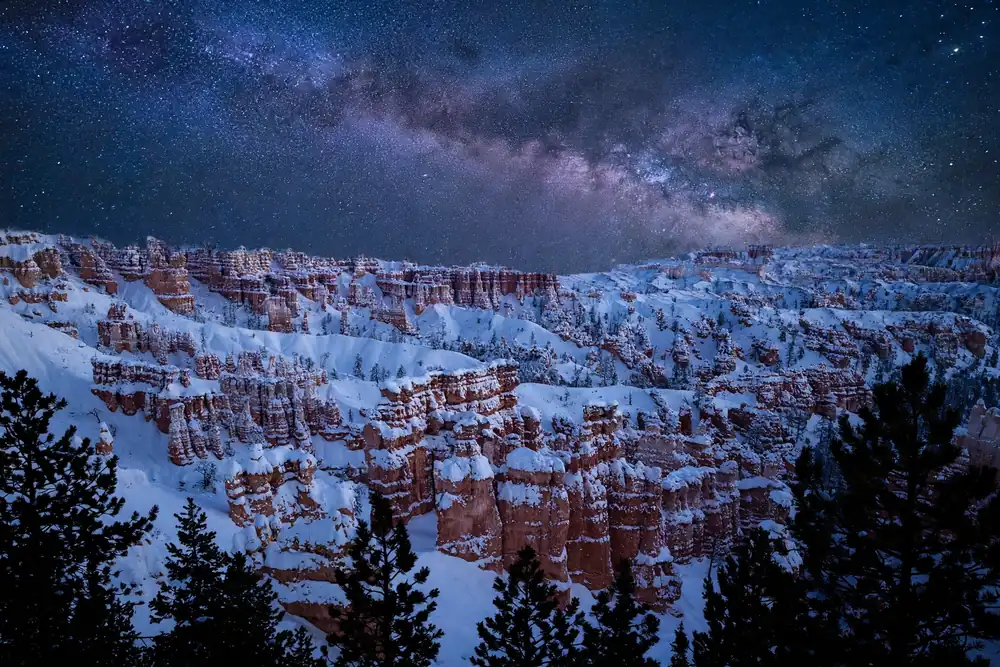
Bryce Canyon is famous for dark skies, and winter plays to that strength. The nights are the longest of the year, the air is dry and usually crystal clear, and there are no summer crowds standing between you and the stars. On a moonless night the winter constellations blaze over the snowfields, and the snow itself reflects enough starlight that the amphitheater never goes fully black.
The trade is cold. Temperatures fall fast after sunset, and stargazing means standing still in them, so dress for ten degrees colder than the thermometer says and give yourself a hard time limit if the wind picks up. If your visit lines up with a full moon instead, take the consolation prize: moonlight on snow lights the amphitheater well enough to read the landscape, which is exactly why the park’s full moon hikes work.
Where to Sleep and Eat When the Lodge Goes Dark
Winter removes the park’s own beds. The Lodge at Bryce Canyon, the only hotel inside the park, closes for the winter along with its dining room, and the general store near Sunrise Point closes too. Nobody should plan a winter trip around staying inside the park.
Bryce Canyon City, the small town at the park entrance, becomes the base instead. Ruby’s Inn is the anchor there: open year-round, minutes from the entrance, with restaurants, a general store, and the Winter Adventure Center for rentals. Other motels in town open through the season, and the towns of Tropic, about twenty minutes east, and Panguitch, about half an hour northwest, add quieter and often cheaper options. Winter rates outside the holiday weeks are the lowest of the year, which softens the numbers in our Utah Mighty 5 trip cost breakdown.
Camping is possible but serious. North Campground keeps Loop A open on a first come, first served basis through winter, with no running water or dump station until spring. Sunset Campground closes for the season. With lows in the teens, winter camping at Bryce is for people with four-season gear and experience, not a money-saving improvisation.
Driving Here in Winter: Plows, Chains, and Patience
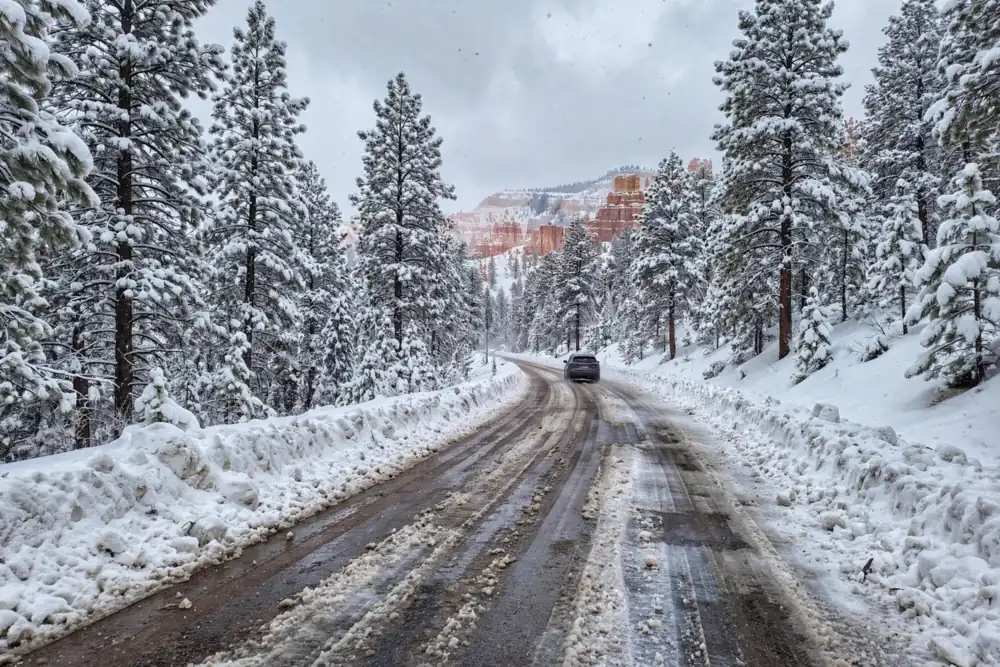
You reach Bryce on Highway 12, then turn south onto Highway 63, the park spur. The park road from the entrance is plowed through winter, but plowed does not mean bare, and conditions can change within a single storm. Check the park’s conditions page before you set out, and check Utah’s UDOT traffic reports for the highways outside the park, especially if you are crossing from Zion or Escalante.
A winter car kit for Bryce is simple and non-negotiable:
- Chains or proper winter tires. Carry traction for your vehicle and know how to fit it before you need it on a dark roadside.
- A full tank and a scraper. Fuel stops are sparse, and every morning starts with ice on the glass.
- Warmth in reserve. Blankets, water, snacks, and a phone charger, in case a closure turns a drive into a wait.
- Daylight where you can get it. Wildlife drifts onto the roads at dusk, and black ice is invisible after dark.
Drive gently and leave big gaps. The amphitheater viewpoints are only a few miles inside the park, so on a rough day you can see the best of Bryce without ever committing to the southern road.
How Many Days You Need, and Who Should Skip Winter
One full winter day covers the amphitheater viewpoints and a below-the-rim hike with traction. Two days is the sweet spot: it adds snowshoeing or skiing, a shot at the Southern Scenic Drive, and a second sunrise if the first one clouds over. A third day only pays off if you ski seriously or a storm parks itself over the plateau and you want to watch it work.
On a winter Mighty 5 loop, treat Bryce as the cold outlier. It sits thousands of feet higher than Zion and runs fifteen to twenty degrees colder, so give it your most flexible day and your warmest layers. Underestimating Bryce’s elevation is already one of the classic Mighty 5 road trip mistakes in summer. In January it stops being a comfort issue and becomes the whole trip.
Skip winter, honestly, if any of these sound like you:
- You get one shot at Bryce. If this is a once-in-a-decade trip and you need every trail and road open, come between May and October instead.
- You hate being cold. No viewpoint fixes single-digit wind chill, and winter Bryce asks for hours of it.
- Snow driving scares you. That is a reasonable fear at 9,000 feet, and the park will still be here in June.
- Your dates have no flex. A two-night trip in a storm cycle can become a one-viewpoint trip. Winter rewards travelers who can shift a day.
For everyone else, the deal is simple. Bryce Canyon in winter trades warmth and certainty for the most dramatic version of the park there is: snow on every hoodoo, light that lasts all day, trails you share with almost no one, and nights dark enough to remind you why this corner of Utah keeps its reputation. Dress properly, check the conditions twice, and go early in the day. The cold is manageable. The memory of that first white amphitheater at sunrise is not something summer can give you.