
Best Arches in Arches National Park Besides Delicate Arch
Delicate Arch gets the license plate, the sunset crowds, and the three mile hike, and it deserves all three. But the best arches in Arches National Park are not a single arch. The park holds more than 2,000 of them, and the ones beyond Delicate Arch are the reason a day here feels like walking through a gallery rather than queuing for one famous painting. Some are taller than Delicate Arch. One is longer than any other arch in North America. And several of them sit a few steps from the car, which means you can see a dozen arches in a day without ever lacing up for a hard hike.
This guide covers the best arches in Arches National Park beyond Delicate Arch, organized by area so you can plan by the road instead of by a list. The Windows Section comes first, then Devils Garden at the end of the road, then the easy roadside stops, then the one arch that takes a dirt road and some patience. Every arch below has its trail length, its effort, and its best light, and the table near the end puts them side by side. If you want the full day built around these stops, our one day in Arches National Park guide lays out the road order. And if Delicate Arch is still on your list, our Delicate Arch hike guide covers that trail step by step.
The Windows Section: Three Arches in One Short Loop
The Windows Section sits about 12 miles from the park entrance, and it holds the densest cluster of big arches in the park. North Window, South Window, Turret Arch, and Double Arch all sit within just over two square miles, and the parking lot serves two trailheads a short walk apart. This is the stop to make first if you arrive after sunrise, because the light is good here all morning and the walks are short enough to fit between the bigger hikes.
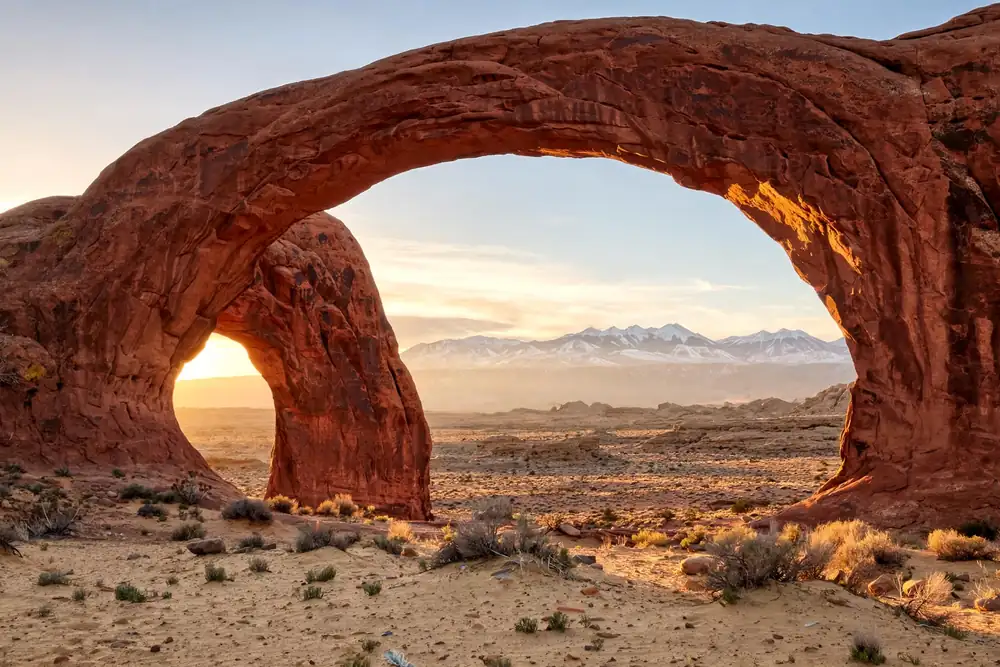
Double Arch is the showpiece of the section, and the numbers explain why. It is the tallest arch in the park at 112 feet, and the second longest at 144 feet, two spans joined at one end over a sandy floor you can walk right up to. The trail is a gentle 0.6 miles round trip that takes 15 to 30 minutes, and it is considered barrier free with some assistance, which makes it the easiest big arch in the park to reach. Stand underneath it and look up, because the two openings frame the sky in a way no photograph quite captures, and the rock above you is thin enough to make you glad the park keeps visitors off the spans themselves.
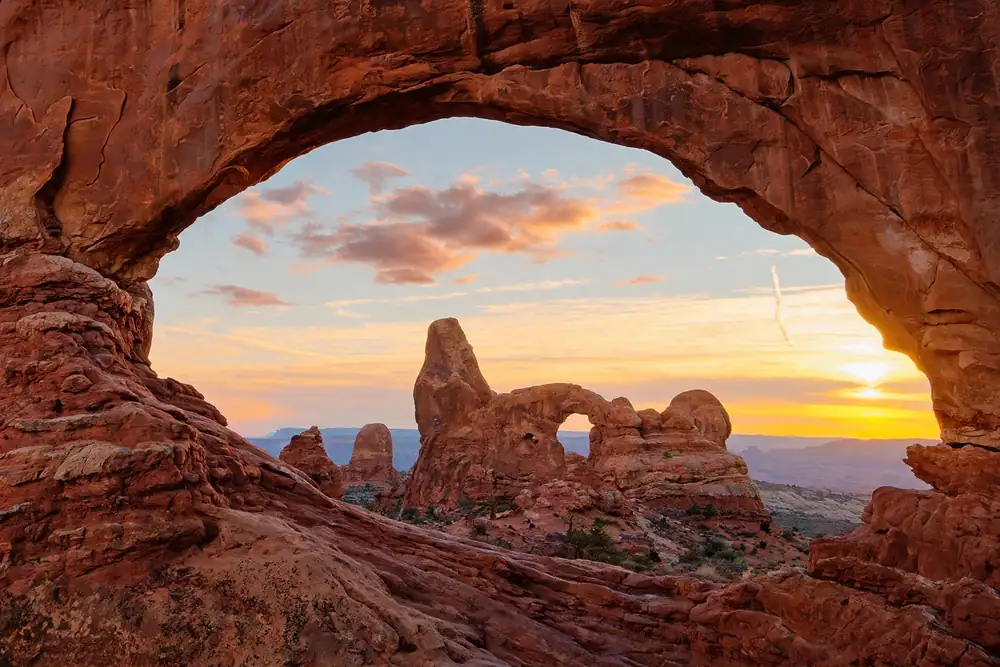
Across the lot, the Windows loop climbs a gravel trail to the North Window, the South Window, and Turret Arch. The full loop is about a mile round trip and takes 30 to 60 minutes, with a shorter 0.6 mile loop that reaches the three arches and turns back. North Window is the larger of the two windows, a massive opening you can walk right up to and look through, and the pair is sometimes called the Spectacles for the way the two openings sit side by side in a single fin. Turret Arch stands a short spur off the main trail, a 65 foot tower with an opening at its base, and looking back through Turret Arch frames both windows in one shot, which is why photographers gather here at sunrise.
The Windows Section is also the most forgiving stop in the park for timing. The arches face east, so the morning light comes straight through the openings, and the North Window fills with sunrise watchers on clear mornings. By midday the lot is full and the loop is busy, so come here first thing or late in the afternoon, when the low sun turns the fins gold and the crowds thin out.
Devils Garden: The Longest Arch and the Deepest Bench
Devils Garden sits at the end of the park road, 18 miles from the entrance, and it is where the park stops being a driving tour and becomes a hike. The trailhead offers everything from an easy graded walk to a strenuous 7.9 mile loop, and the arches here reward the walkers. Eight named arches sit along the main trail and its spurs, and the first of them is the one that justifies the drive on its own.
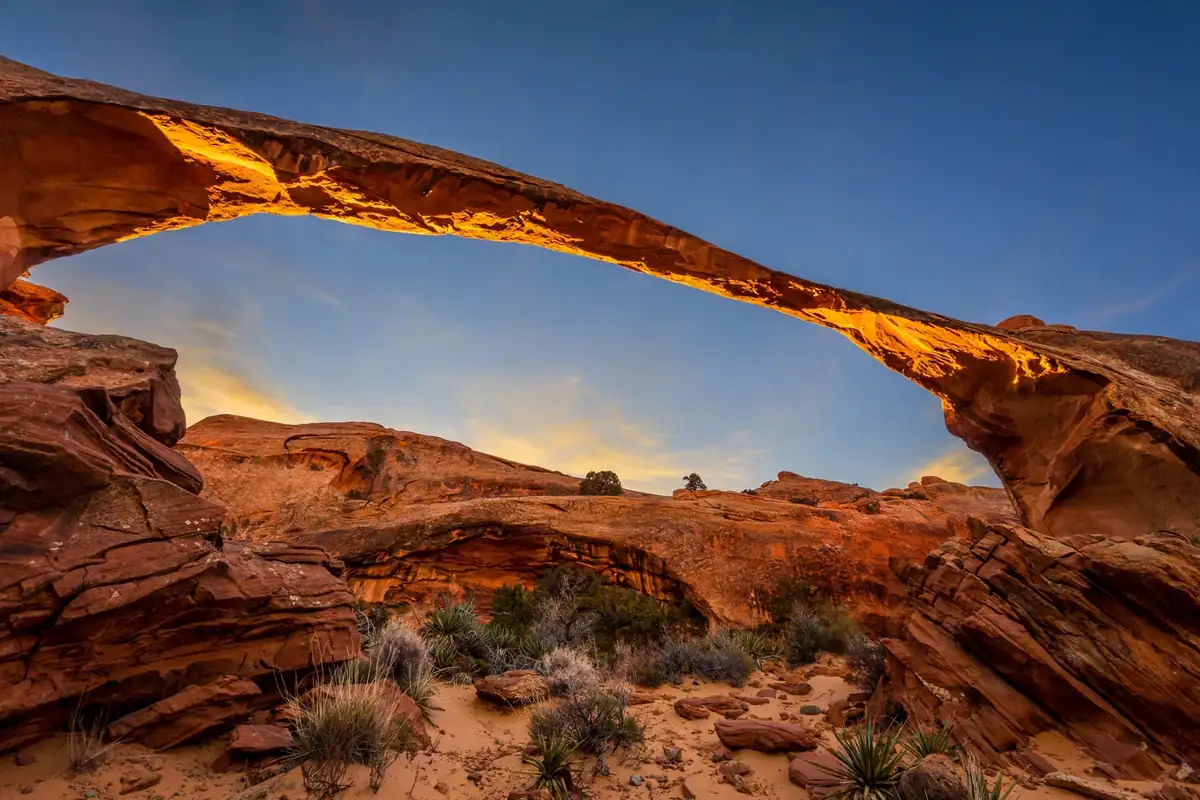
Landscape Arch is the longest arch in North America, with a light opening of 306 feet, and it is only 6 feet thick at its narrowest point. The trail to it is an easy 1.8 miles round trip on a hard packed path that takes 30 to 60 minutes, with spur trails to Pine Tree Arch and Tunnel Arch adding about half a mile. The arch is a thin ribbon of rock that looks too fragile to stand, and the park agrees, because large segments of it crashed down in the 1990s and the ground beneath it is now closed off. The National Park Service trail page lists the walk as easy, though the final stretch has steep slopes that may need assistance, and the morning light strikes the ribbon face on and shows just how thin it really is.
Past Landscape Arch the trail climbs over slickrock slabs, and a spur trail about a third of a mile further on splits to two more arches. Partition Arch frames the La Sal Mountains through its opening and catches the sunrise head on, which makes it the best dawn photograph in Devils Garden. Navajo Arch sits a few steps away in a shady alcove, a low dark opening that stays cool at midday when the rest of the trail is in full sun. The spur to both arches adds about 0.8 miles round trip and half an hour, and it is the best value detour in the park.
Double O Arch is the turnaround for most hikers who do not want the full loop, and it is 4 miles round trip from the trailhead over steep slickrock with narrow ledges and drop offs. The arch itself is two stacked openings in a single fin, and the light is best in the late afternoon, when the sun drops behind the fins and the upper opening glows. Dark Angel, a tall sandstone pillar, stands 0.4 miles beyond Double O for anyone with energy left. Past Double O the trail becomes the Primitive Trail, a 2.1 mile one way stretch of route finding and scrambling that closes the 7.9 mile loop, and Private Arch hides on a short spur along it, a small low arch that most hikers walk past without noticing.
Devils Garden is the one area in the park where the parking lot decides the day. It fills early, the trailhead has toilets year round and drinking water from spring through fall, and the full loop needs at least 3 quarts of water per person. Start here first if Landscape Arch is your priority, or save it for the cooler afternoon and do the Windows Section at dawn.
The Easy Roadside Arches: Sand Dune, Broken, and Skyline
Not every great arch in the park needs a hike, and the three roadside stops between the Windows and Devils Garden prove it. Each one is a short walk from a paved pullout, and together they take about an hour, which makes them the easiest arches to add to any day.
Sand Dune Arch hides between tall sandstone fins at the end of a 0.4 mile trail through deep sand, and it is the most secluded arch on this list. The walk takes 15 to 30 minutes, the fins shade the trail even at midday, and the arch itself is a low span over soft sand that children love and photographers use for shade portraits. Do not climb or jump off the arch, because the sandstone is thin and the park is explicit about it, and wear shoes you do not mind filling with sand.
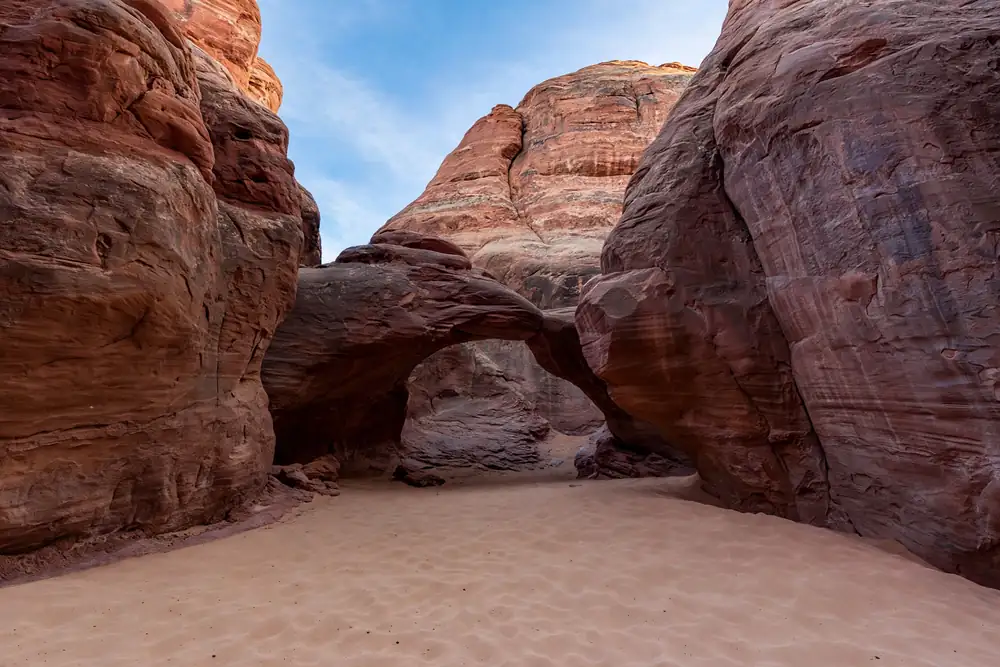
Broken Arch sits across the grassland from the same trailhead, a 1.2 mile round trip walk that crosses open meadow to an arch perched above a pygmy forest of pinon and juniper. The name is a joke the rock plays on first time visitors, because the arch is not broken at all, only cracked, and the opening is still intact. The full loop runs 2.3 miles round trip in about an hour and threads through the campground, with a short scramble in one section, so the out and back is the better call for most visitors.
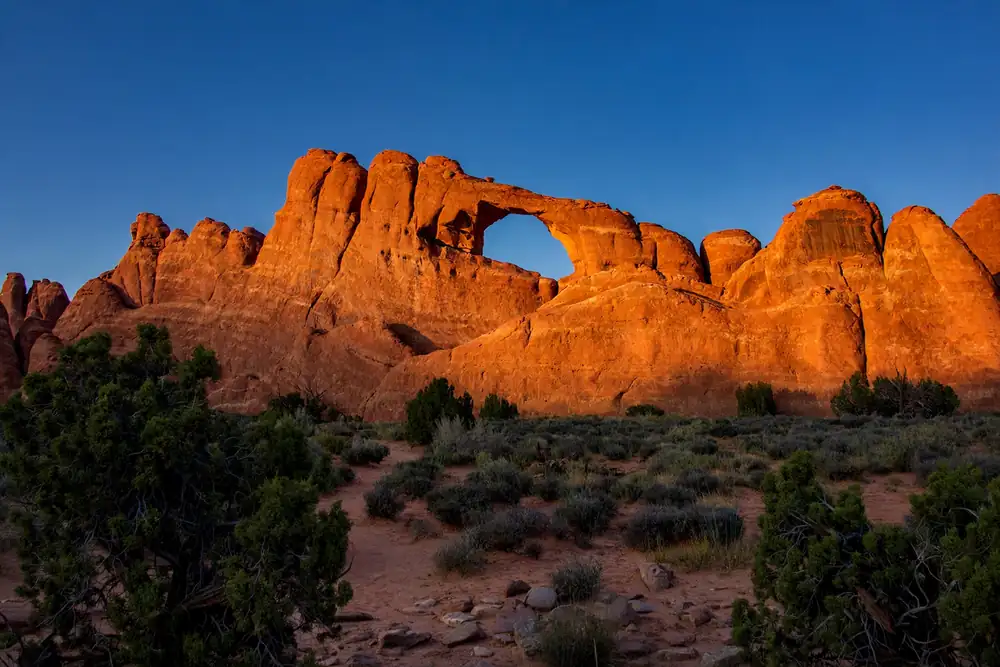
Skyline Arch is the last of the three, a short 0.4 mile out and back trail at the far end of the campground road that takes 10 to 20 minutes. The arch sits high in a wall, and its opening is twice the size it was a century ago, because a large boulder fell out of it in 1940 and the rockfall is still visible at the base of the trail. The first steps of the trail make it inaccessible to wheelchairs, but the park points visitors to a paved path from the campground amphitheater that views the arch from the opposite side. Come at sunset, when the west facing wall catches the last light.
Tower Arch: The Quiet One at the End of a Dirt Road
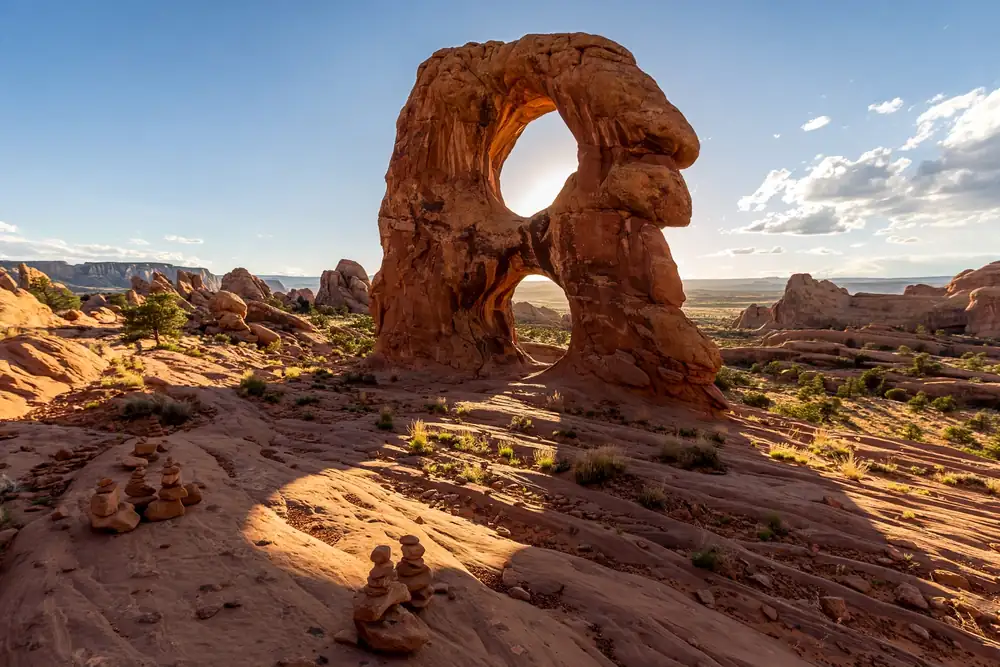
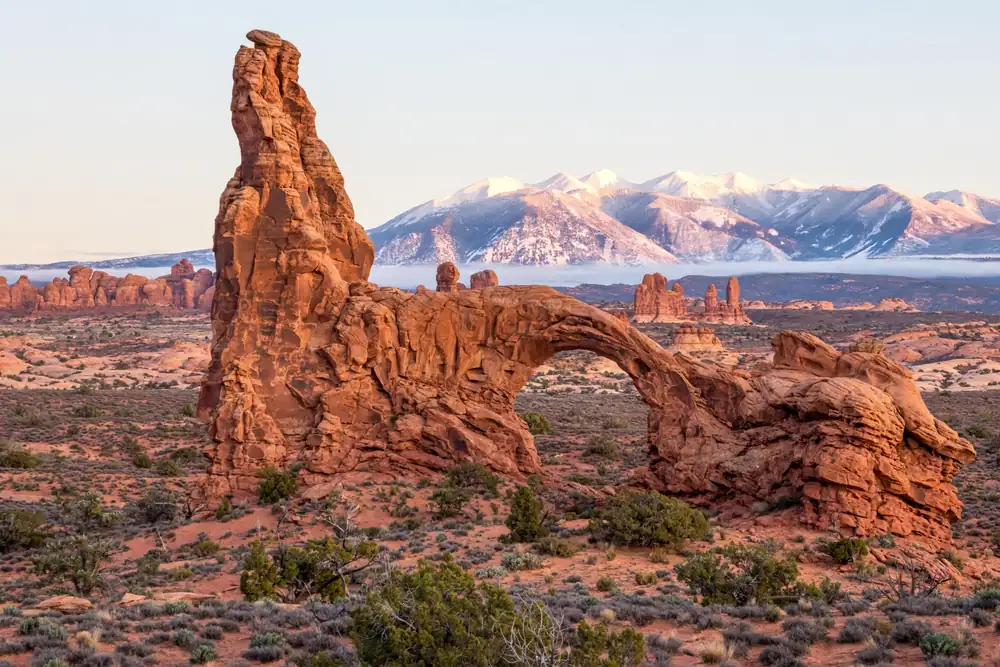
Tower Arch is the arch for visitors who have already seen the famous ones and want the park to themselves. It sits in the Klondike Bluffs in the remote northwest corner of the park, reached by Salt Valley Road, a dirt road the park says is two wheel drive in normal conditions. The drive is about seven miles of dirt from the main park road to the junction, and the trail from the regular trailhead is about three miles round trip through fins and sand. A rough four wheel drive road continues another 3.3 miles to a closer trailhead, where the walk shortens to about 0.6 miles, but that road needs high clearance and low range gearing, and the park warns that rain and snow can make any unpaved road impassable in a hurry.
The arch itself spans about 92 feet beneath a tall sandstone tower, and the view east takes in the La Sal Mountains across the valley. It is the least visited named arch in the park, which is the whole point, and the morning light is the best time to see it, before the heat builds on the exposed trail. Check the road conditions at the visitor center before you go, carry more water than you think you need, and do not attempt the four wheel drive road in a rental sedan, because the tow bill will cost more than the photograph.
The Best Arches in Arches National Park, Compared
|
Arch |
Best light |
Trail length |
Effort |
Where |
|---|---|---|---|---|
|
Double Arch |
Morning |
0.6 mi |
Easy |
Windows Section |
|
North Window |
Sunrise |
1 mi loop |
Easy |
Windows Section |
|
Turret Arch |
Sunrise |
1 mi loop |
Easy |
Windows Section |
|
Landscape Arch |
Morning |
1.8 mi |
Easy |
Devils Garden |
|
Partition Arch |
Sunrise |
0.8 mi spur |
Easy to moderate |
Devils Garden |
|
Double O Arch |
Late afternoon |
4.0 mi |
Strenuous |
Devils Garden |
|
Sand Dune Arch |
Midday shade |
0.4 mi |
Easy |
Roadside |
|
Broken Arch |
Morning |
1.2 mi |
Easy |
Roadside |
|
Skyline Arch |
Sunset |
0.4 mi |
Easy |
Devils Garden Campground |
|
Tower Arch |
Morning |
About 3 mi |
Moderate |
Klondike Bluffs |
Read the table as a planning tool, not a ranking. The easy arches cluster in the Windows Section and along the road, and the strenuous ones sit at the end of it, which is why the order that works is windows at dawn, Devils Garden in the cool hours, and the roadside stops in between. If you only have two hours, do the Windows Section and Sand Dune Arch. If you have a full day, add Devils Garden to Double O and finish at Skyline Arch for sunset.
Best Light for Each Arch
Sunrise belongs to the east facing arches, and three of them do it best. North Window fills with watchers before dawn, because the sun rises straight through the opening and the light pours into the amphitheater below. Partition Arch frames the La Sals at first light, and the glow on the distant peaks is the photograph that makes the Devils Garden climb worth it. Turret Arch works at sunrise too, because the low sun throws the tower’s shadow across the trail and the opening frames the windows behind it.
Morning light suits Landscape Arch and Double Arch, which both face east and catch the sun full on before the heat builds. Landscape Arch is at its thinnest and most dramatic in the first hour, when the ribbon glows against the shadowed canyon behind it. Midday is the time for the shaded arches, Sand Dune Arch between its fins and Navajo Arch in its alcove, which stay cool and photogenic while the exposed trails bake.
Late afternoon belongs to Double O Arch, where the sun drops behind the fins and the upper opening catches the last direct light. Sunset belongs to Skyline Arch, whose high west facing wall turns orange in the final minutes, and to Tower Arch, where the low sun rakes across the tower and the valley below. The park is an International Dark Sky Park, so staying past sunset at the Windows Section trades the arches for the Milky Way, and the same lots that were full at noon are empty by dark.
Practical Notes: Fee, Parking, and the Reservation That No Longer Exists
The money is simple. The entrance fee is $30 per private vehicle, $25 per motorcycle, and $15 per person on foot or bicycle, good for seven days, and youth 15 and under enter free. The entrance station takes credit and debit cards only, so do not count on paying cash. The $55 Southeast Utah annual pass covers Arches and Canyonlands plus Natural Bridges and Hovenweep for US residents, and the America the Beautiful pass costs $80 for US residents and $250 for nonresidents.
For four years, visiting Arches meant booking a timed entry ticket in advance, and that era ended in February 2026, when the park announced it would not run a timed entry reservation system for the year. You can now drive to the entrance station at any time during operating hours with no advance ticket, and the park is open 24 hours a day, year round. The park’s announcement lifting the reservation requirement is worth a read before your trip, because the rules can change again in a future year. Reservations are still required for Devils Garden Campground and for Fiery Furnace hikes, which need a ranger or a permit to enter, and those are booked on Recreation.gov.
What replaced the ticket system is parking, and the park is honest about it. Between March and October the entrance wait can exceed 60 minutes, the lots at the Windows, Delicate Arch, and Devils Garden fill early, and rangers may temporarily restrict access to a full area until spaces open up. Arrive before 8 in the morning in spring and fall, and have a second stop ready for any lot that is full. Summer temperatures regularly pass 100 degrees, the park has drinking water only at the visitor center and Devils Garden Campground, and the exposed trails need at least 2 quarts of water per person. Our Utah national parks packing list covers the water and layers, and our Utah Mighty 5 trip cost breakdown shows how the Arches fee fits a full trip budget. If you are choosing a month, our best time to visit Utah’s national parks guide compares the seasons across all five parks.
The Bottom Line
The best arches in Arches National Park beyond Delicate Arch are not a consolation prize. Double Arch is taller, Landscape Arch is longer, the Windows give you three arches in one short loop, and Tower Arch gives you the park to yourself at the end of a dirt road. Pick one sunrise arch, one Devils Garden hike, and one roadside stop, and you will have seen the park the way it deserves to be seen, which is arch by arch instead of all at once. Our Mesa Arch sunrise guide covers the other famous sunrise arch in the region, and the bigger loop that connects all five parks is in our 7 day Utah Mighty 5 road trip itinerary. Two thousand arches, one road, and a full day to walk it. That is the whole guide, and it is enough.