
Best Bryce Canyon Viewpoints for Photos: Where to Stand, and When

Bryce Canyon is not a hiking park first and a viewpoint park second. It is the other way around. The whole park is one rim looking east into a single amphitheater of hoodoos, and the difference between a good photo and a great one is almost never the camera. It is the hour. The amphitheater faces east, so the sun rises straight into it, lights the tops of the spires first, and works its way down for about twenty minutes while the whole bowl glows. Get that hour right and almost any of the Bryce Canyon viewpoints will give you a keeper. Get it wrong and you will wonder what everyone was talking about.
This guide organizes the Bryce Canyon viewpoints by light, not by road order, because light is what decides them. Sunrise viewpoints first, then sunset, then the in-between hours, then the southern drive, then the night sky, which is a viewpoint of its own here. Every viewpoint below is one you can drive to, park at, and walk to in minutes, with the honest tradeoffs stated: which ones duplicate each other, which ones fill with cars before dawn, and which ones are worth the extra miles. If you are still deciding when to come, our guide to the best time to visit Utah’s national parks compares the seasons across all five parks.
Why Bryce Is a Light Park First
The first fact to understand is the direction. The Bryce Amphitheater opens to the east, and the rim you stand on runs north to south at about 8,000 to 9,100 feet. Morning sun comes straight over the far rim and into the hoodoos. That is why sunrise beats sunset at Bryce, and why the park’s own viewpoints page calls Sunrise Point equally spectacular at daybreak and day’s end while photographers still set their alarms for dawn. The light starts at the top of the spires and slides down, so the tallest formations catch fire first and the canyon floor stays in cool shadow. By mid-morning the glow is gone and the rock goes flat and pale, which is the worst hour to judge the place.
The second fact is the scale. The main road runs 18 miles one way, from the entrance to Rainbow Point, and the amphitheater viewpoints sit in the first three miles. Everything after that is the Southern Scenic Drive, a quieter road of forested canyons and long-distance views. Most visitors never drive past Bryce Point, which means the southern viewpoints are the emptiest in the park and the amphitheater ones are the most crowded. Plan around that split and you will spend the golden hours where the light is best and the midday hours where the crowds are not.
Sunrise: Bryce Point, Then Sunrise Point
Bryce Point is the sunrise pick, and it is the widest view in the park. It sits at the southern end of the amphitheater at about 8,300 feet, and from its rim you look north across the entire bowl, the Silent City stretching away in layers, with Inspiration, Sunset, and Sunrise Points all visible along the far rim. The panorama is the payoff, and it is also the reason to arrive 30 to 45 minutes before sunrise. The sky changes color long before the sun clears the horizon, the hoodoo tops catch the first light, and the parking lot fills before first light in summer. Bryce Point is a shuttle stop in season, and it is also the trailhead for the Rim Trail, the Peekaboo Loop, and the Under-the-Rim Trail, so it stays busy even after the sunrise crowd leaves.
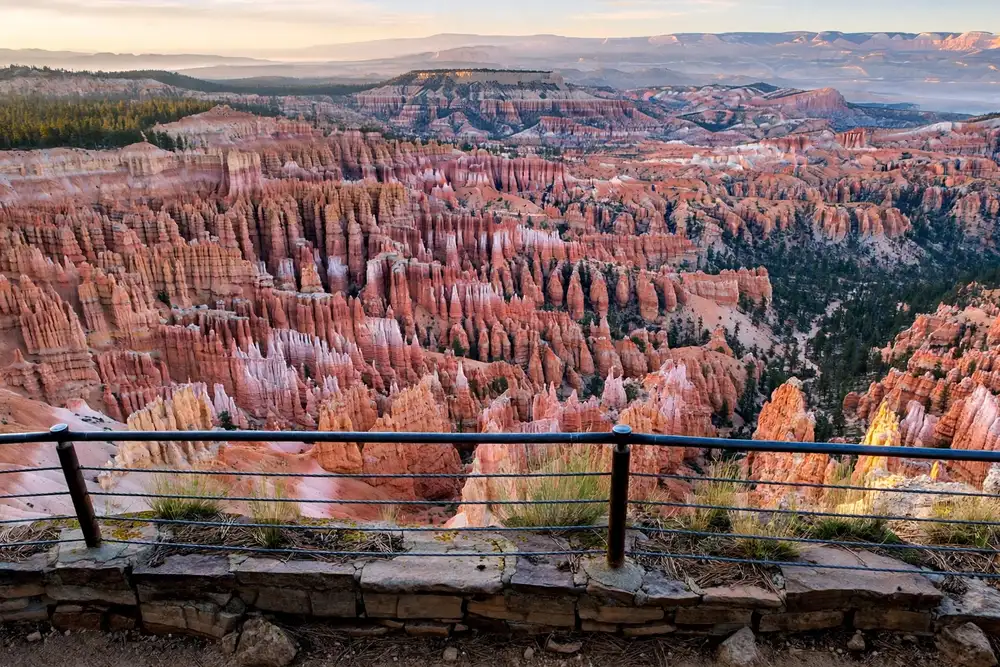
Sunrise Point is the second sunrise choice, and the more obvious one. It is the northernmost viewpoint in the amphitheater, and it looks south and east across Boat Mesa, the Sinking Ship, and the spires of Fairyland Canyon. The light here is the same east light as Bryce Point, only closer and lower, which makes it better for tight compositions of individual hoodoo groups and worse for the grand panorama. It is also the most crowded sunrise spot in the park, because the name does the advertising. If the lot is full, do not circle it. Drive five minutes to Bryce Point instead, where the view is bigger and the crowd is thinner. A paved half mile of Rim Trail connects Sunrise Point and Sunset Point, so the two are one easy walk apart.

Sunset: Paria View, Then Sunset Point
Paria View is the sunset pick, and it is the one viewpoint in the park built for evening light. It faces west, which makes it the exception in an east-facing park, and it overlooks an amphitheater more than 500 feet deep that most visitors never see. A castle-like hoodoo stands near the rim and turns gold in the last hour of light, and the viewpoint is quiet because it sits on a short spur road off the main drive that many drivers pass without noticing. Go here for sunset, arrive well before the sun drops, and stay through the color change, because the light keeps working after the sun is gone.
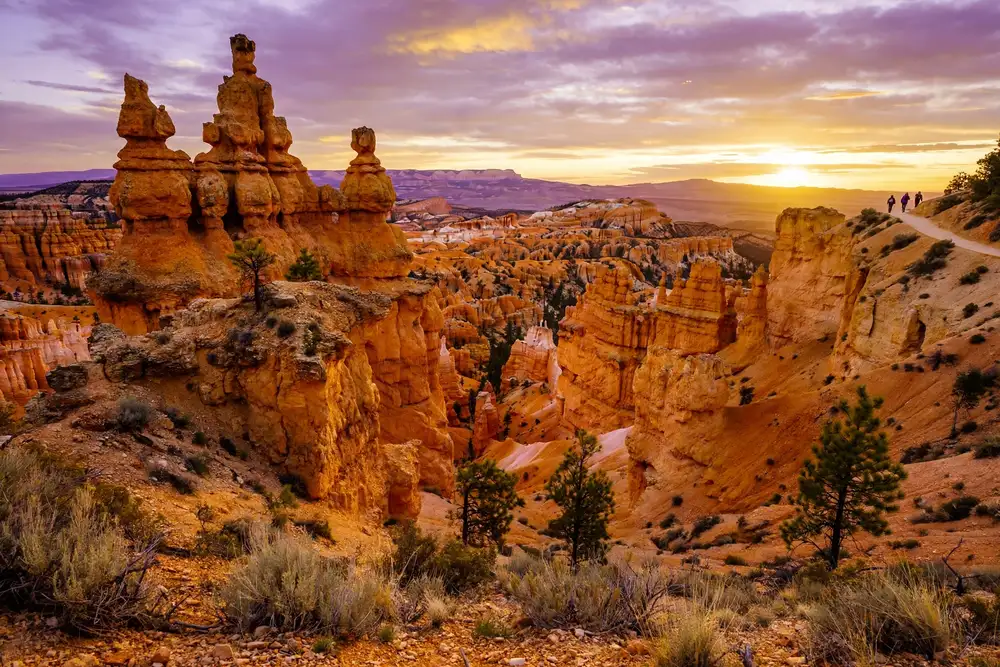
Sunset Point is the famous name, and the honest truth about it is that it is good at both ends of the day. Its name promises sunset, and the golden hour before sunset does light Thor’s Hammer, the tall spire with the capstone that stands just below the rim, in warm low-angle light with long shadows. But the amphitheater faces east, so the setting sun is behind you at Sunset Point, which lights the walls beautifully without ever putting the sun in your frame. That is fine for photography and it is why the point works at sunrise too, when the first light hits Thor’s Hammer head on. Sunset Point is also the trailhead for the Navajo Loop, so it is the busiest viewpoint in the park at midday. Our Navajo Loop and Queen’s Garden guide starts from this trailhead and drops into the hoodoos the viewpoint looks over.
The In-Between Light: Inspiration Point and the Rim Walk
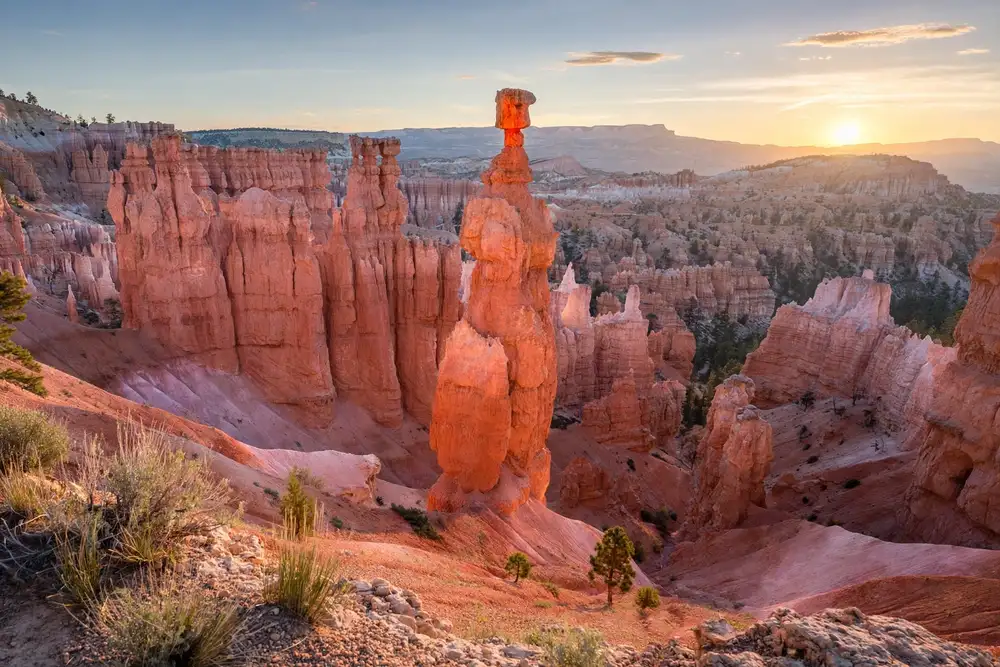
Inspiration Point is the viewpoint to visit when the light is neither sunrise nor sunset, because its subject is scale rather than color. It sits on three levels, Upper, Mid, and Lower, and from the upper level you get a bird’s-eye view down into the Silent City, the densest field of hoodoos in the amphitheater. The park calls it a bird’s-eye view of the world’s largest collection of hoodoos, and from the rim it reads as a maze rather than a wall, which is what makes it different from the other three amphitheater viewpoints. Come in late morning, when the sun is high enough to light the canyon floor, and walk the short paved path between the three levels for three different framings of the same maze.

The Rim Trail ties the amphitheater viewpoints together, and it is the best way to see them without moving the car. About half a mile of paved trail runs between Sunrise Point and Sunset Point, and the stretch from Sunset Point to Inspiration Point runs about three quarters of a mile along the rim. The full Rim Trail runs 5.5 miles from Fairyland Point to Bryce Point, but the amphitheater section is the useful part for photographers, because it lets you walk from viewpoint to viewpoint as the light changes. One winter warning belongs here: the section of Rim Trail between Bryce Point and Inspiration Point closes in winter, so check conditions before planning a rim walk in the cold months.
Midday and the Southern Drive: Natural Bridge to Rainbow Point
Midday is the wrong hour for the amphitheater and the right hour for the Southern Scenic Drive, because the southern viewpoints face south and west into open country rather than into the east-facing bowl. The drive runs 15 miles past the amphitheater to Rainbow Point, and the smart way to do it is to drive straight to the end first and stop on the way back north, so every pullout is on your right and you never cross traffic. The stops are smaller and quieter than the amphitheater, and they reward a different kind of photo: long horizons, forest, and single features rather than the full bowl.
Natural Bridge is the first southern stop most people photograph, and the name is a misnomer worth knowing. The feature is not a bridge but a natural arch, a window in a sandstone fin formed by ice expanding in cracks deep within the rock, and it frames green ponderosa pine forest rather than hoodoos. It photographs best in mid-morning light, when the sun is high enough to light the arch face, and it is a roadside pullout, so the whole stop takes five minutes.

Past the bridge, the viewpoints change character. Agua Canyon holds two named hoodoos, The Hunter on the left and The Rabbit on the right, and it is a good stop for a single-feature composition. Farview Point looks south across the Grand Staircase, and on most days you can see Navajo Mountain, 90 miles away on the Utah and Arizona border. Swamp Canyon marks the transition from hoodoo country to steep cliffs and buttes, and Black Birch Canyon and Ponderosa Canyon are the forested stops in between, named for the trees on the canyon floor rather than the rock above it.
Rainbow Point and Yovimpa Point end the road at 9,115 feet, the highest viewpoints in the park, and they are the payoff for the whole southern drive. The two points sit a short walk apart and offer different vistas: Rainbow looks south across the Grand Staircase and into Arizona on a clear day, and Yovimpa looks across rugged canyons to the south and east. The Bristlecone Loop, a one-mile trail at the top, is the only walk up here, and it is worth it for the oldest trees in the park as much as for the view. Come at midday or in the afternoon, when the amphitheater light is at its worst and the southern horizon is at its clearest.
The Quiet Corner: Fairyland Point
Fairyland Point is the viewpoint most visitors drive past without knowing it exists, and that is its appeal. It is the northernmost viewpoint along the rim, and its turnoff sits just inside the park boundary, before the fee booth, a short drive north of the visitor center and then east. The view looks across Fairyland Canyon, a smaller amphitheater of hoodoos that feels wilder than the main bowl because almost nobody stops here. It is also a trailhead for the Fairyland Loop, the 8-mile hike that circles the canyon, so the parking lot serves hikers more than photographers.
Come here for the quiet and for morning light, and come here when the amphitheater lots are full. The light is the same east light as Sunrise Point, only the composition is looser and the foreground is forest rather than rim wall. It is also the best viewpoint in the park for a picnic, because the lot is large, the trees are close, and the view is yours alone on most mornings.
After Dark: Bryce Under the Stars
Bryce Canyon is a Gold Tier International Dark Sky Park, designated in 2019, and the night sky is the park’s second show. On a moonless night the Milky Way is bright enough to cast a faint shadow, and the hoodoos make a foreground no other dark sky park can match. The best stargazing spots are the viewpoints away from the lodge lights, and Bryce Point and Paria View are the two most often recommended, because both have open sky in every direction and dark foregrounds below the rim. The park runs ranger-led night sky programs through the warmer months and an Astronomy Festival each June, timed to the new moon, with telescope viewing that needs a free same-day ticket from the visitor center.
The practical rules are simple. Check the moon phase before you book, because a full moon washes out the Milky Way. Bring a jacket even in summer, because the rim sits above 8,000 feet and cools fast after dark. Use a red light rather than a white one, keep your headlights off at the viewpoint, and give your eyes twenty minutes to adjust. The park is open 24 hours a day, so there is no closing time to beat, and the same viewpoints that crowd at sunrise are empty after dark.
Winter at the Viewpoints
Winter changes the viewpoints more than any other season, and mostly for the better. Snow on orange rock is the most photogenic combination in the park, and the crowds are gone, so the amphitheater viewpoints feel like a different place from December through February. The tradeoff is access. Roads close temporarily during and after winter storms until plowing is finished and conditions are safe, so check the park’s conditions page on the morning of your visit. The Rim Trail section between Bryce Point and Inspiration Point closes in winter, and the southern drive can close after heavy snow, so Rainbow Point is not guaranteed in the cold months. The visitor center keeps winter hours, 8 am to 4:30 pm from November through early April, and the shuttle does not run in winter, which means you drive yourself and park where you can. Our Bryce Canyon in winter guide covers the cold season in full, including which trails stay open and what to wear.
The Bryce Canyon Viewpoints, Compared
|
Viewpoint |
Best time |
Faces |
Getting there |
Walk |
Best for |
|---|---|---|---|---|---|
|
Sunrise Point |
Sunrise |
East |
Drive or shuttle, amphitheater |
Paved rim, flat |
First light on the hoodoos |
|
Sunset Point |
Sunrise and golden hour |
East |
Drive or shuttle, amphitheater |
Paved rim, flat |
Thor’s Hammer, all-day classic |
|
Inspiration Point |
Late morning |
East |
Drive or shuttle, amphitheater |
Short paved path, three levels |
The Silent City from above |
|
Bryce Point |
Sunrise |
East and north |
Drive or shuttle, amphitheater |
Paved rim, flat |
The widest panorama in the park |
|
Paria View |
Sunset |
West |
Short spur drive, amphitheater |
Paved rim, flat |
Real sunset light, quiet |
|
Fairyland Point |
Morning |
East |
Drive, north of visitor center |
Paved rim, flat |
Quiet, picnic, Fairyland Canyon |
|
Natural Bridge |
Mid-morning |
East |
Roadside pullout, southern drive |
None, view from the car |
The arch, five minutes |
|
Agua Canyon |
Midday |
South |
Roadside pullout, southern drive |
None, view from the car |
The Hunter and the Rabbit |
|
Farview Point |
Midday |
South |
Roadside pullout, southern drive |
None, view from the car |
Navajo Mountain, 90 miles away |
|
Rainbow and Yovimpa Points |
Afternoon |
South |
End of the scenic drive |
Short walk between points |
Highest views, Grand Staircase |
Read the table as a planning tool, not a ranking. The amphitheater viewpoints reward the early hours and the southern viewpoints reward the middle of the day, and the only viewpoint built for sunset is Paria View. If anyone in your group has limited mobility, the amphitheater viewpoints are the easy choice, because Sunrise, Sunset, Inspiration, and Bryce Points all have paved rim areas, while the southern drive is best enjoyed from the car.
What to Skip
Not every viewpoint earns a stop, and saying so honestly saves a day. Sunrise, Sunset, and Inspiration Points all look into the same amphitheater from different angles, and if you are short on time, pick two and skip one. Inspiration Point is the one to keep if you want scale, Sunset Point is the one to keep if you want Thor’s Hammer, and Sunrise Point is the one to keep if you want the classic first-light frame. The southern viewpoints repeat each other more than the amphitheater ones do: Agua Canyon, Black Birch Canyon, and Ponderosa Canyon are all short pullouts with a single feature, and if the light is flat, drive past two of them and save the stop for Natural Bridge and Rainbow Point.
Do not try to photograph all thirteen viewpoints in one day. The drive is 18 miles one way and the stops add up, and by the third amphitheater viewpoint the photos start to look the same. Pick one sunrise viewpoint, one sunset viewpoint, one midday drive, and one night sky spot, and let the rest wait for a second visit. The park rewards patience more than coverage.
Practical Notes: Fee, Shuttle, Parking, and the Drive
The money is simple. The entrance fee is $35 per private vehicle, $30 per motorcycle, and $20 per person on foot or bicycle for visitors aged 16 and over, good for seven days, and youth 15 and under enter free. Non-US residents aged 16 and over pay an additional $100 per person unless they enter on an annual or America the Beautiful pass. The Bryce Canyon annual pass costs $70 and the America the Beautiful pass costs $80 for US residents. The park is cashless at the entrance, so bring a card. There is no timed-entry reservation and no advance ticket, and the park is open 24 hours a day, year-round.
The shuttle is free with park admission and runs from early April through mid-October, with the 2026 season running April 3 to October 18. It serves the amphitheater only, Bryce, Inspiration, Sunset, and Sunrise Points plus the lodge and visitor center, roughly every 15 minutes, and it is optional, not mandatory. Unlike Zion, you can drive your own vehicle through Bryce even while the shuttle is running. That freedom has a cost: parking at Sunrise and Bryce Points fills before first light in summer, vehicles 23 feet or longer cannot park at many amphitheater viewpoints during shuttle hours, and trailers or RVs longer than 20 feet must be left at the visitor center or your campsite. The park’s viewpoints page lists every viewpoint with its own notes, and it is worth a read before the trip. Our Utah Mighty 5 trip cost breakdown shows how the Bryce fee fits a full trip budget, and our Utah national parks packing list covers the layers and water the high rim demands.
The Bottom Line
Bryce Canyon viewpoints reward one decision above all others: get up for sunrise. The amphitheater faces east, the light works down the hoodoos for twenty minutes, and no other hour in the park comes close. Bryce Point gives you the widest version of that morning, Sunrise Point gives you the closest, and Paria View gives you the sunset the amphitheater cannot. Between them, Inspiration Point covers the middle of the day and Rainbow Point covers the far horizon, and after dark the same rim turns into one of the darkest skies in America. Our one day in Bryce Canyon itinerary turns these viewpoints into a full day, and the bigger loop that connects all five parks is in our 7 day Utah Mighty 5 road trip itinerary. One rim, one road, and the light doing the work. That is the whole guide, and it is enough.