
8 Easy Hikes in Zion National Park: Paved Walks, Waterfalls, and One Honest Stretch
Zion National Park draws nearly five million visitors a year, more than any other park in Utah, and most of them arrive with the same two hikes in mind. Angels Landing and the Narrows earn every bit of their fame, but they are not the whole park, and they are not easy hikes by any honest measure. This guide covers 8 easy hikes in Zion National Park that were verified open against National Park Service sources in early November 2026, with every distance, elevation figure, and shuttle stop checked against NPS trail pages. Two trails are deliberately left out because they are closed, and the section near the end explains exactly why.
The eight are organized by who each hike suits best, not by a ranking. One is the only trail in the park where dogs are allowed, one is the best walk with small kids, one is a waterfall walk, one is a quiet picnic connector, one is a 30 minute history lesson, one is the best view for the least effort, and one is a sandy stretch that earns its place only if you know what the sand will cost you. One is a short paved walk to a dripping alcove with hanging gardens. A comparison table, a closures check, and the shuttle and fee details follow the eight. If you are still deciding when to come, our guide to the best time to visit Utah’s national parks compares the seasons across all five parks.
What “Easy” Honestly Means in Zion
The Park Service defines its easy hikes as trails from 0.4 miles to 3.5 miles long that gain no more than 100 feet in elevation, and six of the eight hikes in this guide fit that definition cleanly. Canyon Overlook and Sand Bench are the two honest exceptions, and that is exactly why they are flagged in the table below. Canyon Overlook climbs 163 feet in one mile, and Sand Bench runs 3.9 miles with about 1,000 feet of total elevation change. Both are included because their tread, their access, and their reward still make them good choices for fit beginners, as long as readers go in knowing the one number that breaks the rule, rather than discovering it halfway up.
Easy in Zion still means desert walking, and desert walking has its own rules. Paved does not mean flat, as the Riverside Walk proves once its first gentle stretch ends, and short does not mean shaded, as the Sand Bench proves all the way along. Carry water on every hike, wear shoes with real grip, and check the park’s current conditions page on the morning of your hike, because closures in Zion change fast and a trail open last month can be closed this week for rockfall, flooding, or repairs.
Pa’rus Trail: The Walk Everyone Can Do
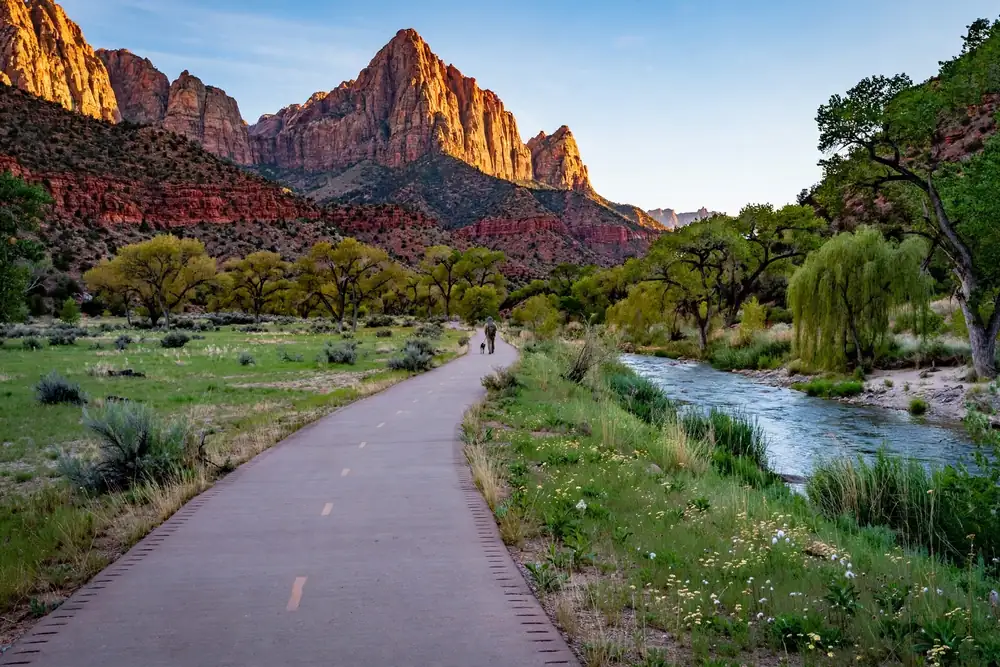
Pa’rus Trail is the most inclusive walk in Zion, and the one to choose first if anyone in your group uses a wheelchair, pushes a stroller, or brings a dog. The trail runs 3.5 miles round trip from the Zion Canyon Visitor Center to Canyon Junction, following the Virgin River across the open canyon floor with about 50 feet of elevation change in total. The surface is paved, wide, and nearly flat, the views of the Watchman and the Towers of the Virgin open up the whole way, and you never need a shuttle to reach it. Walk as much of it as you like and turn around whenever you are ready.
Pa’rus is also the only trail in Zion National Park where dogs are allowed, and the rule is strict and simple. Dogs must stay on a leash no longer than six feet at all times, they are not allowed on shuttle buses or inside public buildings, and they are not allowed on any other named trail in the park. Keep dogs out of the river water, because the park warns about toxic cyanobacteria in the Virgin River and its streams. Bikes share the paved path, so keep to the right, and remember that the open canyon floor offers very little shade, so morning light is kinder than midday.
Riverside Walk: Best With Small Kids
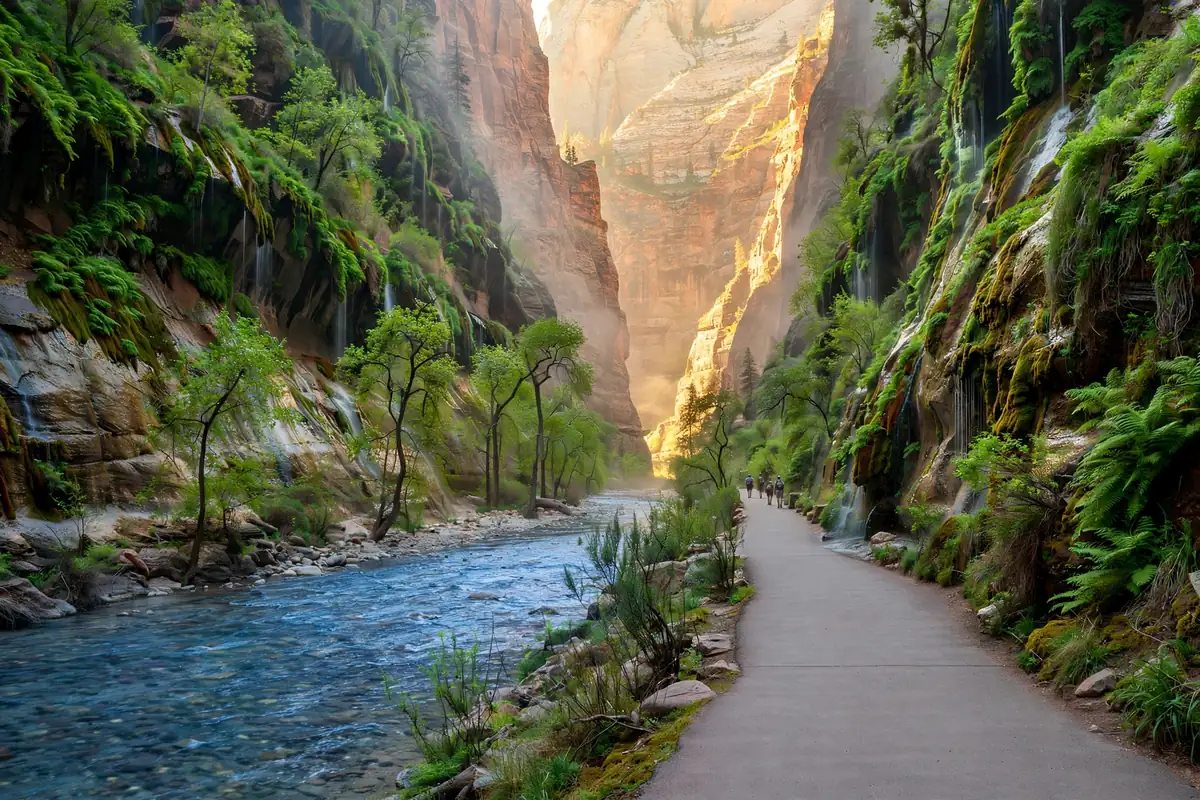
Riverside Walk is the walk most families picture when they imagine Zion, and it is the easiest way to stand inside the big canyon without climbing anything. The paved trail runs 2.2 miles round trip from the Temple of Sinawava, shuttle stop 9, to the place where the canyon walls close in and the Virgin River fills the canyon floor. Hanging gardens drip from the walls above, cottonwoods shade much of the path, and the river runs beside you the whole way. Restrooms and a water filling station sit at the trailhead, and most families take one to two hours at a wandering pace.
Two honest qualifications belong here. The first 0.4 miles are wheelchair accessible, but past that point the path has steeper slopes and patches of sand washed onto the pavement, so some wheelchair users will need assistance to go farther. The second is the Narrows itself, because this walk ends exactly where the river hike begins. The Narrows closes when the river flows above 150 cubic feet per second and whenever a flash flood warning is in effect, and it was under a weather closure alert in early November 2026, so check conditions before you step into the water. Our Narrows guide for beginners covers the river hike in full.
Lower Emerald Pool: The Waterfall Walk
Lower Emerald Pool is the shortest walk in this guide to an actual waterfall, and the one to pick when the group wants a destination without a climb. The trail runs 1.2 miles round trip from Zion Lodge, shuttle stop 5, with about 69 feet of elevation change over a mostly paved path, and it ends at a pool beneath an overhanging sandstone ledge where a thin waterfall drops after rain and snowmelt. The footbridge over the Virgin River at the lodge, closed by a landslide until June 2025, has reopened, so the direct approach from the lodge is available again. Go in the morning, when the trail is quieter, and expect the waterfall to be a trickle rather than a torrent in late summer and fall.
The pool itself deserves a careful word. The paving is rough in places and the trail has inclines and cross slopes, so it is not a level stroll for every visitor, and the rock near the pool gets slippery when wet or icy, so stay out of the pool and off the ledges above it. Lower Emerald Pool is only one part of a bigger trail system, and the Middle and Upper pools are different hikes entirely, at about 2 miles and 3 miles round trip with 150 and 350 feet of climbing, so do not set out for the Lower Pool expecting to drift on to the Upper one without a real climb. Check the signs at the trail junction, because routes in this area have closed before for rockfall.
Grotto Trail: The Quiet Connector
Grotto Trail is the least famous walk on this list, and that is precisely its charm. The trail runs 1 mile round trip between Zion Lodge, shuttle stop 5, and the Grotto Picnic Area, shuttle stop 6, on a mostly level path through cottonwoods and open forest along the river. The Park Service measured it at about 35 to 49 feet of elevation change, and the surface is mostly firm soil with a short paved stretch. There is no single famous view waiting at either end, which is why the crowds skip it, and why deer, wild turkeys, and quiet are easier to find here than almost anywhere else in the main canyon.
Use the Grotto Trail as a connector rather than a destination, and it earns its place in the day. Walk it one way from the lodge to the picnic area, eat lunch at the picnic tables under the trees, and catch the shuttle from stop 6 to your next trailhead, which saves one bus ride and one wait. It also pairs naturally with the Emerald Pools trails, since all three sit within a short walk of each other. One caution from the Park Service assessment: a short stretch narrows to about 15 inches wide, so it is not a fully accessible route, and wheelchairs and wide strollers should use the shuttle between the two stops instead.

Archeology Trail: History in 30 Minutes
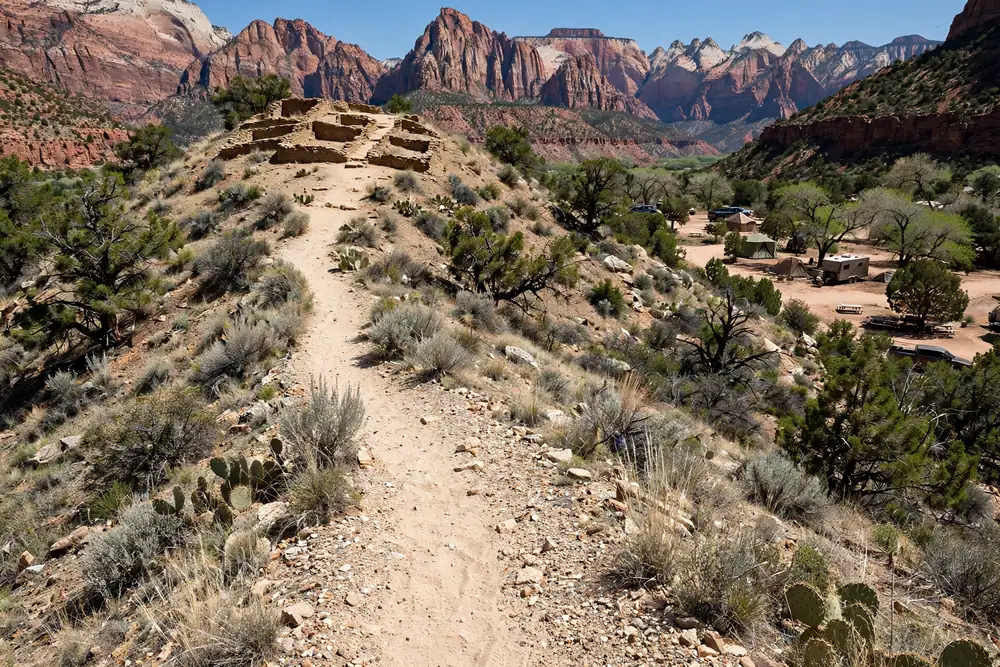
Archeology Trail is the shortest hike in Zion Canyon, and the best use of half an hour you will find anywhere in the park. The trail runs 0.4 miles round trip from behind the Zion Canyon Visitor Center, climbing about 80 feet up a small hill on a sandy path that the Park Service describes honestly as short but steep. At the top sit the outlines of Ancestral Puebloan storage structures, occupied roughly from AD 700 to 950, with trailside exhibits explaining what stood there. The views from the hill run over the visitor center, the Watchman Campground, and the lower canyon.
Do not mistake short for step free, because this trail is not accessible and the sandy slope is the whole challenge. The payoff is proportionate to the effort: real human history older than the park itself, in a quiet spot most visitors walk straight past, and the artifacts found at the site are on display at the Zion Human History Museum at shuttle stop 2. Pair it with the museum visit and the Pa’rus Trail, all within a short walk of the visitor center, and you have a full, easy first morning without ever boarding a shuttle.
Canyon Overlook Trail: The Best View for the Least Effort
Canyon Overlook Trail is the single best trade of effort for view in Zion, and the only hike on this list that the shuttle cannot reach. The trail runs 1 mile round trip from a small parking lot just east of the Zion-Mount Carmel Tunnel, climbing 163 feet over rocky and uneven ground to a fenced viewpoint above Pine Creek Canyon and lower Zion Canyon. The Park Service rates it moderate, not easy, because of the uneven tread and the long drop-offs along the way, most of which are fenced. The view takes in the Great Arch, the switchbacks of the Zion-Mount Carmel Highway far below, and the whole lower canyon in one frame.
The catch is the parking lot, which the Park Service itself calls extremely limited, and which allows right turns only for entry and exit. Arrive early, be ready to circle and try again, and do not block the highway while you wait. The trailhead has pit toilets and no water, and the drive to it crosses the tunnel from the Springdale side, so check the road alerts before you go, since the highway closed for nine days in autumn 2026 after a rockfall. Hold small children’s hands on the unfenced stretches and wear shoes with grip for the rocky sections.

Sand Bench Loop: The Stretch Pick, and the Sand Warning
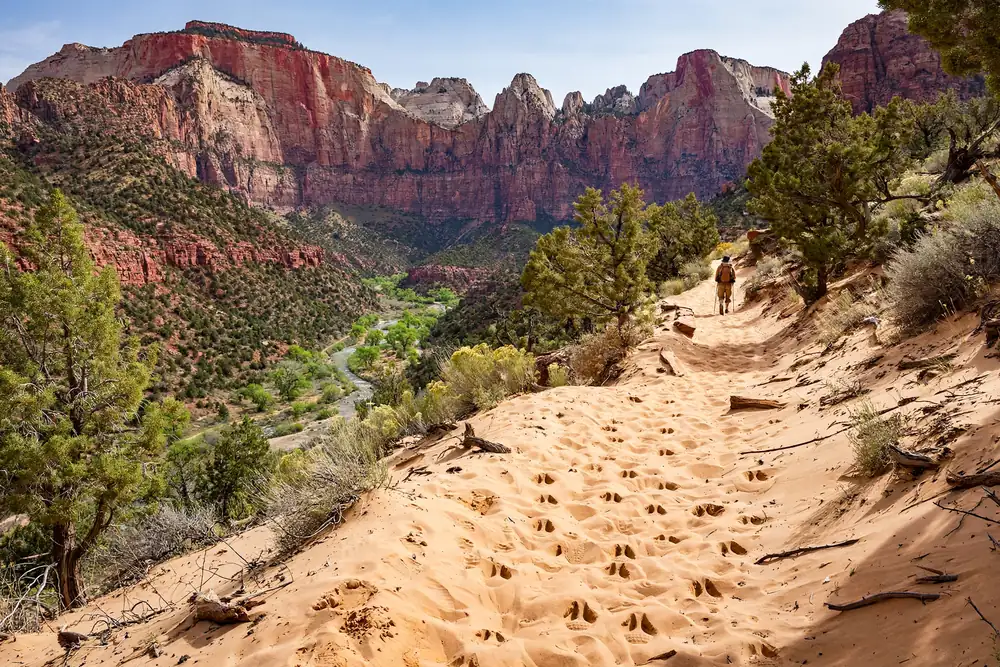
Sand Bench Loop is the only hike on this list that some readers should skip, and this guide says so plainly. The loop runs 3.9 miles from the Court of the Patriarchs, shuttle stop 4, or from Zion Lodge, shuttle stop 5, along the Virgin River and then up onto the remains of an ancient landslide that dammed the river about 8,000 years ago. The Park Service trail assessment measured about 1,000 feet of total climbing across the loop, and two thirds of the tread is very soft sand, which makes every mile feel longer than the number suggests. It is a commercial horse trail from March through October, so expect to step aside for mule trains, and expect deep, churned sand where the horses have passed.
Walk it anyway, in the right conditions, and it is the quietest canyon floor walk in the main canyon, with views of the Towers of the Virgin and long stretches without another person in sight. Go in the cool months, or early or late in the day, carry more water than the distance suggests, and wear shoes you do not mind filling with sand. The trail crosses a small creek that can require wading after rain, and the open bench offers almost no shade, so midday summer is the wrong time for it. If soft sand, full sun, and horse traffic sound like a chore rather than an adventure, skip this one without regret and spend the time on a second slow lap of the Riverside Walk instead.
Weeping Rock Trail: The Short Walk to a Dripping Alcove
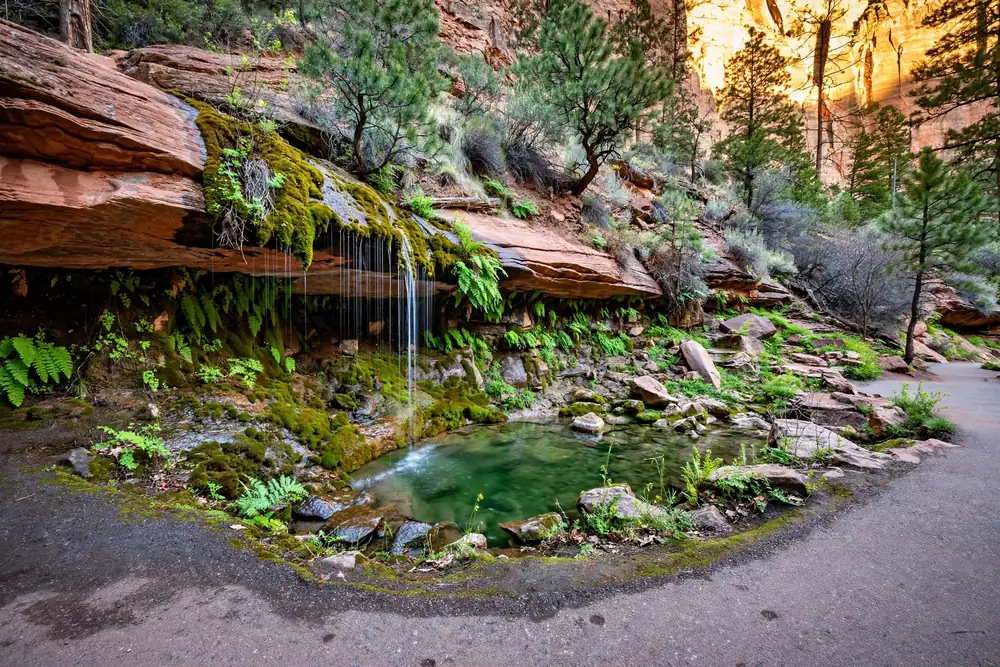
Weeping Rock Trail is a short walk in Zion Canyon to a genuinely different landscape, and it is the newest addition to this list for a happy reason. The trail closed after a rockfall in November 2023, and the Park Service reopened it on September 5, 2025 after repairs, so it is open now. The walk is 0.4 miles round trip with 98 feet of climbing on a paved path from Shuttle Stop 7, and it ends at a dripping alcove where water seeps from the sandstone above and feeds the hanging gardens on the rock face.
Go expecting a quiet pause rather than a workout, because the alcove itself is the reward. Stand under the overhang and you will feel the cool drip and see ferns and moss clinging to the wet rock, a small green world in the middle of the desert canyon. It is an easy add on after Riverside Walk or before lunch at the lodge, and it is the best choice in this guide when you want a short walk that still feels like a discovery.
The 8 Easy Hikes in Zion National Park, Compared
|
Trail |
Distance, round trip |
Elevation change |
Difficulty |
Surface |
Getting there |
Best for |
|---|---|---|---|---|---|---|
|
Pa’rus Trail |
3.5 miles |
50 feet |
Easy |
Paved |
Visitor Center, no shuttle needed |
Wheelchairs, strollers, dogs on leash |
|
Riverside Walk |
2.2 miles |
57 feet |
Easy |
Paved |
Shuttle stop 9, Temple of Sinawava |
Small kids, first timers, Narrows views |
|
Lower Emerald Pool |
1.2 miles |
69 feet |
Easy |
Paved, rough in places |
Shuttle stop 5, Zion Lodge |
A waterfall without a climb |
|
Grotto Trail |
1.0 miles |
35 to 49 feet |
Easy |
Firm soil, some paving |
Shuttle stops 5 and 6 |
A quiet picnic connector |
|
Archeology Trail |
0.4 miles |
80 feet |
Easy, short but steep |
Sandy dirt |
Visitor Center, no shuttle needed |
History in 30 minutes |
|
Canyon Overlook Trail |
1.0 miles |
163 feet |
Moderate |
Rocky and uneven |
Drive, east side of the tunnel |
Best view for least effort |
|
Sand Bench Loop |
3.9 miles, loop |
About 1,000 feet total |
Moderate |
Mostly deep soft sand |
Shuttle stops 4 or 5 |
Solitude and a real workout |
|
Weeping Rock Trail |
0.4 miles |
98 feet |
Easy |
Paved |
Shuttle stop 7 |
A dripping alcove with hanging gardens |
Read the table as a planning tool, not a ranking. The distances are round trip figures from Park Service trail pages, the elevation figures are the park’s own, and the difficulty column uses the park’s ratings, with the Archeology Trail kept attached to its own warning that it is short but steep. If anyone in your group has limited mobility, Pa’rus Trail and the first 0.4 miles of the Riverside Walk are the two genuinely accessible choices.
Two Trails You Cannot Hike Right Now
Hidden Canyon is closed, and any guide that lists it without saying so is out of date. The East Rim Trail is partially closed after a large rockfall, so Hidden Canyon cannot be reached, and Observation Point cannot be reached from Zion Canyon either, although it can still be reached by hiking in from the east side of the park. Weeping Rock Trail, by contrast, is open again: it closed after a rockfall in November 2023, and the Park Service reopened it on September 5, 2025, and it is now included in this guide above.
The Watchman Trail is the second closure, and the more surprising one, because it starts right at the visitor center. The Park Service closed it pending repairs on August 31, 2026, and no confirmed reopening date has been announced, so check the park’s current conditions page before planning around it. It is a 3.3 mile moderate trail with about 480 feet of climbing, and it will be a fine addition to this list the day it reopens, but it is not hikeable today. The same caution applies to the Kolob Canyons side of the park, where the Kolob Canyons Road was closed beyond the South Fork trailhead after a rockfall in October 2026, which put the Timber Creek Overlook Trail out of reach by car, so check the road status before driving out to Kolob Canyons.
The Shuttle, the Fee, and a Sensible Easy Day
Zion Canyon works differently from the other Utah parks, because from early spring to late fall the Zion Canyon Scenic Drive is open only to the free park shuttle, and private vehicles are not allowed on it at any hour. The 2026 shuttle season ran from March 7 to November 28, with the fall schedule from October 25 running a first bus at 7 am from the visitor center, a last bus up the canyon at 5 pm, and a last bus out of the Temple of Sinawava at 6:15 pm. No ticket or reservation is needed to ride, and a separate free town shuttle runs through Springdale, but the visitor center parking lot fills between 8 and 9 am on most days, so an early arrival or a Springdale parking spot plus the town shuttle is the realistic plan. When the shuttle is not running, from November 29 to December 25, 2026, and again after the holiday service from December 26 to January 2, private vehicles may drive the Scenic Drive themselves, though the park may still close the road temporarily when the canyon parking fills.
The entrance fee is $35 per private vehicle, $30 per motorcycle, and $20 per person on foot or bicycle for visitors aged 16 and over, good for seven days, and youth 15 and under enter free. Non-US residents aged 16 and over pay an additional $100 per person unless they enter on an annual or America the Beautiful pass, the Zion annual pass costs $70, and the America the Beautiful pass costs $80 for US residents. The park’s fees page carries the full pass list. A sensible easy day uses the shuttle rather than fighting it: ride to the Temple of Sinawava first for the Riverside Walk while the canyon is cool and quiet, come back down to the lodge for the Grotto Trail and Lower Emerald Pool in the late morning, and save Pa’rus Trail for the golden light of late afternoon. Keep Canyon Overlook for a separate east side drive, and keep the Archeology Trail for arrival day. Our one day in Zion National Park itinerary covers the full day that mixes these easy walks with the bigger sights, and the same rule that runs through our Utah national parks packing list applies here: water, sun protection, and an early start matter more than fitness on every trail in this guide.
The Bottom Line
Easy hikes in Zion National Park are not a consolation prize for skipping the famous hard ones. They are the walks that show the canyon floor, the river, the hanging gardens, the waterfall, and the human history, all without a permit lottery, a chain section, or a river wade. Start with Pa’rus Trail or the Riverside Walk, add Lower Emerald Pool and the Grotto Trail while you are in the middle of the canyon, and keep Canyon Overlook for the view that makes the whole trip feel complete. Check the closures on the morning you go, because Zion closes trails faster than guidebooks update, and the two closed trails in this guide are the proof.
The desert parks reward people who carry water and start early, and nowhere is that more true than on a short, sunny, deceptively easy walk in Zion. For the harder half of the park, our Angels Landing permit guide explains the lottery, and the bigger loop that connects all five parks is in our 7 day Utah Mighty 5 road trip itinerary. Eight hikes, one shuttle, and the canyon at walking pace. That is the whole formula, and it is enough.