Goblin Valley State Park: The Best Detour Between Capitol Reef and Moab
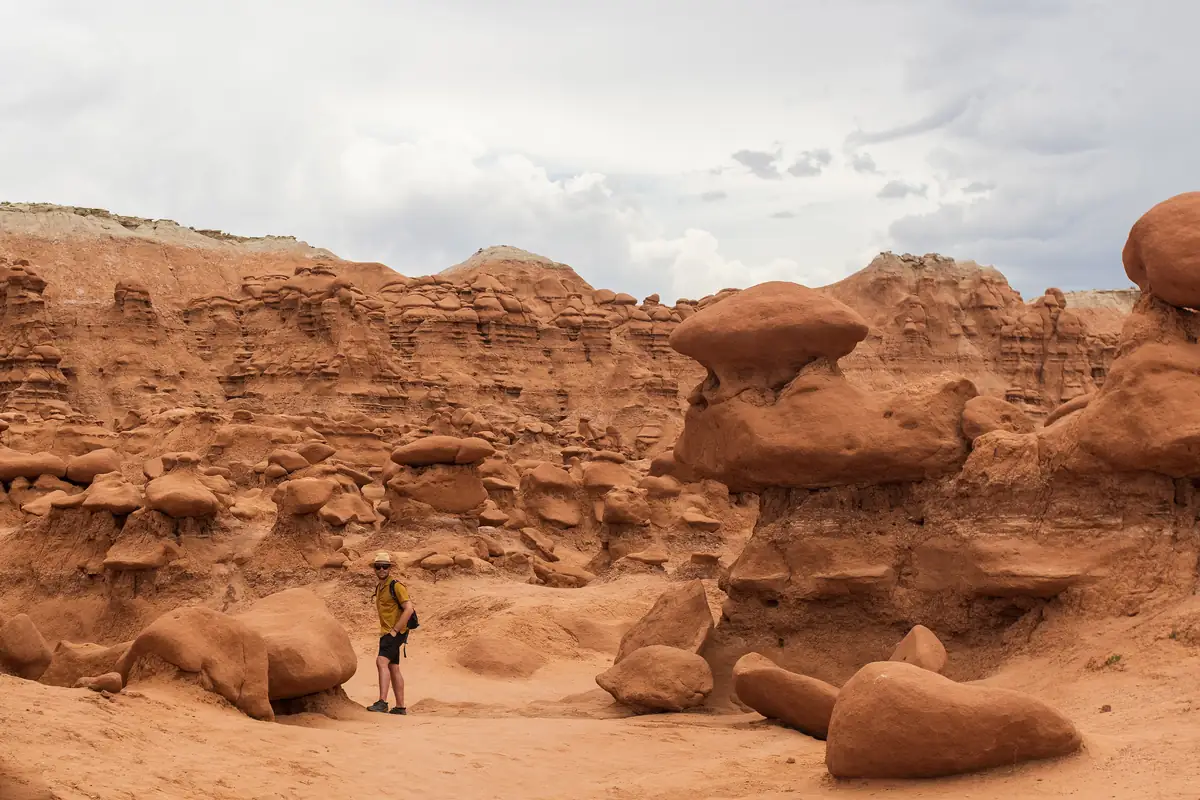
Goblin Valley State Park is the strangest stop on the Mighty 5 route, and one of the easiest to fit in. It sits on Utah Highway 24 between Capitol Reef and Moab, about 12 miles off the highway down a paved side road, and it asks for two or three hours of a driving day. The valley floor is covered with thousands of mushroom-shaped sandstone figures, called goblins, and visitors are free to walk among them with no marked trail and no ropes. For current fees, hours, and campground details, see the official Goblin Valley State Park page from Utah State Parks.
This guide treats Goblin Valley as what it is: a detour, not a destination that needs a full day. It covers the drive from Capitol Reef to Moab, the $20 fee, how the Valley of Goblins works, the short hikes, and when to stay the night for the dark skies. Our 7-day Mighty 5 itinerary shows where this detour falls in the week.
The Short Answer: Is Goblin Valley Worth the Detour?
Yes, for almost every Mighty 5 road trip, Goblin Valley State Park is worth two to three hours. The detour is short, the walking is easy, and the place delivers something the five national parks do not: a landscape you can wander through freely instead of viewing from a trail or an overlook. Families with children get the most out of it, because the valley floor works like a natural playground. The only trips that should skip it are the ones already short on time between Capitol Reef and Moab, or the ones driving the route in the middle of a summer afternoon.
Plan on two hours for the valley and the short trails, or three hours if the Goblin’s Lair hike is included. The park charges $20 per private vehicle, and that pass is good until 10 pm the day after purchase, so a late afternoon visit still leaves the next morning open. The America the Beautiful pass does not work here, because this is a state park and not a national park. Fuel up and pack food in Hanksville or Torrey first, because there is no gas or food beyond the visitor center.
What Goblin Valley Actually Is
Goblin Valley State Park protects a valley of Entrada sandstone hoodoos on the southern edge of the San Rafael Swell, about 50 miles southwest of Green River. The goblins are mushroom-shaped rock figures formed over millions of years as wind and water wore away the Entrada sandstone, which was laid down about 170 million years ago when the area was a tidal flat beside an ancient sea. Harder caprock resisted erosion while the softer rock below dissolved faster, leaving the rounded caps and curved stems. The goblins range from knee height to taller than a person.
The park’s history is short and plain. Prospector Arthur Chaffin came across the valley in the late 1920s while looking for a route through the area, and he called it Mushroom Valley. He returned in 1949 to photograph the formations, and the state of Utah later acquired the land and officially designated it a state park on August 24, 1964. The park sits at about 5,000 feet of elevation, which keeps it cooler than the canyon country to the south, and the 1999 film Galaxy Quest used the valley as a filming location because the scenery already looked like another planet.
Fitting Goblin Valley Into a Mighty 5 Route
Goblin Valley State Park fits the Mighty 5 route in exactly one place: the drive between Capitol Reef and Moab on Utah Highway 24. From Fruita, at the heart of Capitol Reef, the drive to the park takes about an hour and 35 minutes to two hours, heading east on UT-24 through Hanksville and then north to the signed turnoff. From Hanksville itself the drive is only 35 to 45 minutes, which makes Hanksville the natural fuel and food stop before the turnoff. The turnoff sits 24 miles south of Interstate 70, and the paved park road runs about 12 miles from the highway to the entrance.
From Goblin Valley to Moab, allow about two and a half to three hours of driving, heading back to UT-24 and then east through Hanksville, north on Interstate 70, and south on US 191 into Moab. That makes the park a clean afternoon stop on a Capitol Reef to Moab day, with a morning in Capitol Reef, a midday drive, and the night in Moab or at the Goblin Valley campground. Travelers coming from Moab toward Capitol Reef can run the same plan in reverse, with Goblin Valley as a morning stop and Capitol Reef in the afternoon. Our Canyonlands vs Arches guide helps decide what to do with the Moab days that follow, and our one day in Arches guide covers the first park on the other side of the drive.
|
Leg |
Distance |
Drive time |
Notes |
|---|---|---|---|
|
Fruita (Capitol Reef) to Goblin Valley |
About 80 miles |
1 hour 35 minutes to 2 hours |
East on UT-24 through Hanksville, then 12 miles on the park road |
|
Hanksville to Goblin Valley |
About 30 miles |
35 to 45 minutes |
Last fuel and food before the park |
|
Goblin Valley to Moab |
About 130 miles |
2.5 to 3 hours |
UT-24 to Hanksville, I-70 east, US 191 south into Moab |
The Valley of Goblins: Walk Among the Goblins
The Valley of Goblins is the whole reason to stop, and it works differently from any trail in the national parks. There are no maintained trails in the three valleys, no ropes, and no fixed route. Steps from the pavilion at the overlook lead down to the valley floor, and from there visitors are free to roam among the formations across three undeveloped valleys covering about three square miles. Valley 1 sits nearest the parking area, with smaller and more spread-out goblins, and it is the right first stop for families and for anyone short on time. Valley 2 runs on from it with bigger and denser formations, and Valley 3 is the farthest and the densest, a five-mile round trip for visitors who want the full walk.
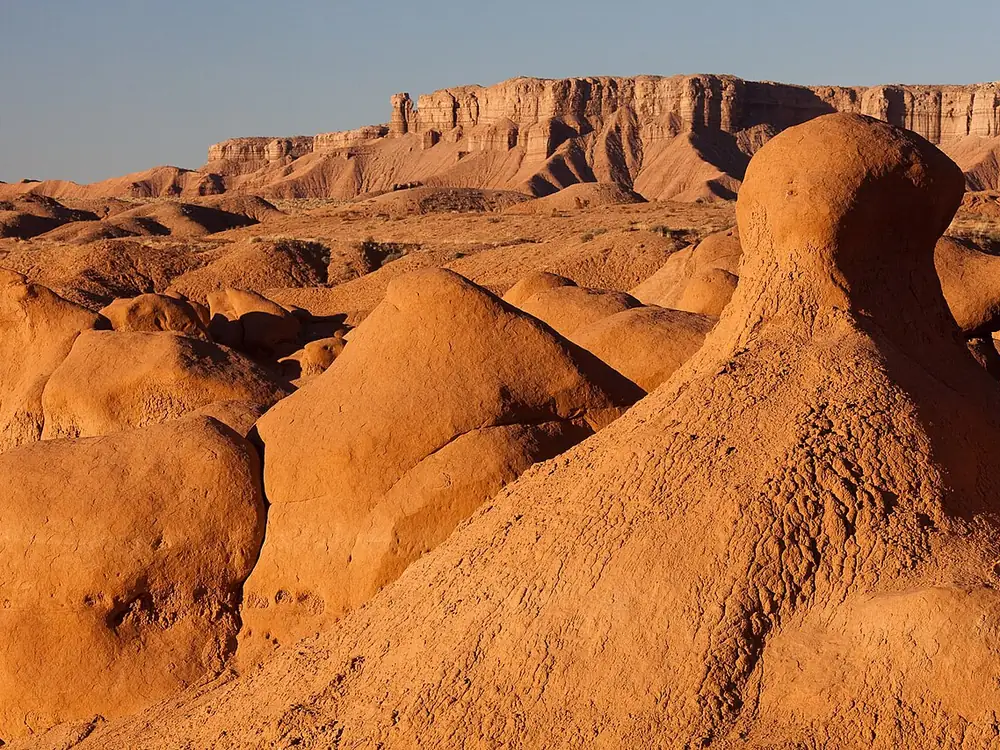
The freedom to roam comes with two rules that matter. The first is to stay off the fragile hoodoos, because the formations are soft sandstone and climbing them breaks the rock and speeds up erosion. The second is to stay on the sand and rock and off the cryptobiotic soil, the dark crusty ground between the formations, because that living crust holds the desert soil together and takes years to recover from a single footprint. The walking itself is easy and mostly flat, on sand, and the parking area stays visible from most of the valleys, so it is hard to get seriously lost. Bring sun protection and water, because there is no shade on the valley floor and the sun reflects off the pale sand.
The Short Trails: Three Sisters and Carmel Canyon
Two short trails sit just beyond the valley floor, and together they take about an hour. The Three Sisters is the most photographed formation in the park, a trio of tall hoodoos that stands apart from the main valley and shows up on most of the park’s souvenirs. The trail to it is only about 250 yards, a quick walk from the road, and it is the best single photo stop in the park after the valley itself.

Carmel Canyon is the more substantial of the two short walks, a 1.5-mile loop rated moderately strenuous that connects to the Goblin’s Lair trail and to the Three Sisters. The loop runs through a narrow canyon with tall walls, which makes it the coolest walk in the park on a hot day, and it gives a completely different view of the formations from below rather than from the valley floor. The trail is uneven in places, with sandy stretches and some scrambling over rock, so wear real hiking shoes even though the distance is short.
The Longer Hike: Goblin’s Lair and Curtis Bench
Goblin’s Lair is the park’s one real adventure, and it is the hike to choose if the stop stretches to half a day. The trail is a 3-mile out and back rated moderately strenuous, starting on the Carmel Canyon loop and leading to a cave on the eastern edge of the park. The route is exposed and sandy, and the last part requires basic bouldering skills to climb into the Lair itself, which is a large cavern with a natural skylight overhead. Rappelling into the Lair is possible only with a $4 per person permit from the visitor center, plus the gear and the skills to use it, so day hikers should plan to walk to the lip and look down rather than counting on a descent.
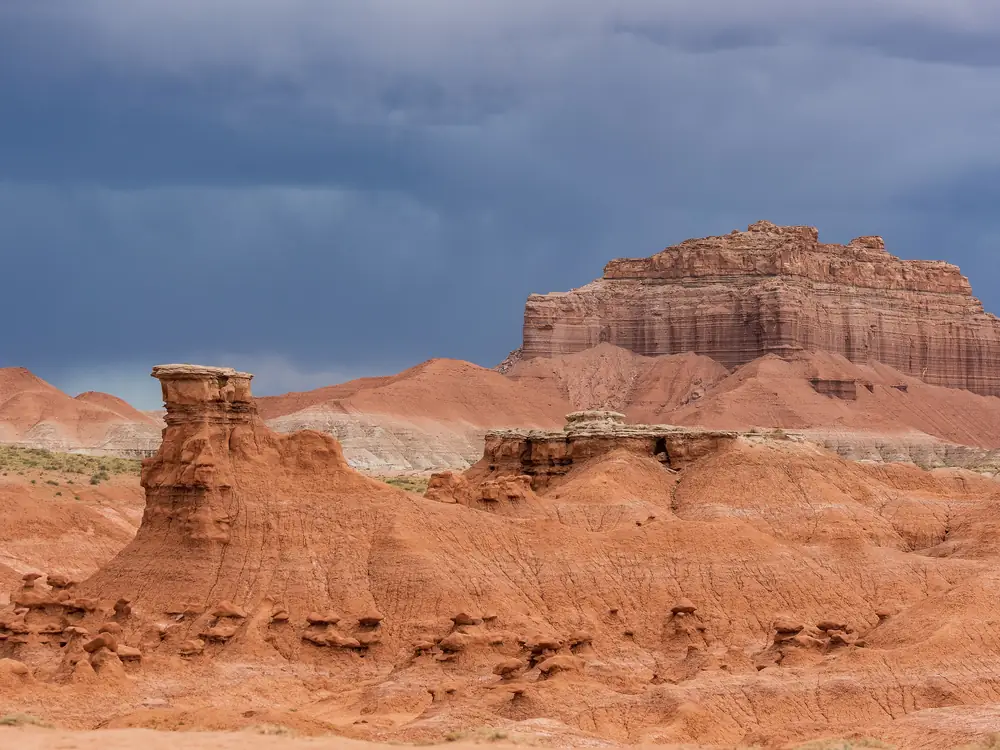
Curtis Bench is the quieter long walk, a 2.1-mile out-and-back trail rated moderate that follows the Curtis Formation along a ridge above the valleys. It offers the best overview in the park, with the goblins below on one side and the Henry Mountains on the other, and it is the trail to pick when the valley floor feels crowded. The trail is exposed and the surface is uneven, so it is best walked in the morning or the late afternoon rather than the middle of the day. Bicycles are allowed only on paved roads and on the approved bike trails near the Curtis Bench Trail, and they are not allowed on the hiking trails, in the campground’s unpaved areas, or in the Valley of Goblins.
|
Trail |
Distance |
Difficulty |
Best for |
|---|---|---|---|
|
Valley of Goblins (Valley 1 and 2) |
Free roam, 1 to 2 hours |
Easy |
Families, first visits, photography |
|
Valley 3 |
5 miles round trip |
Moderate |
The full valley walk, the densest goblins |
|
Three Sisters |
250 yards |
Easy |
The most photographed formation, a quick stop |
|
Carmel Canyon Loop |
1.5 miles |
Moderately strenuous |
A cool canyon walk, the link to Goblin’s Lair |
|
Goblin’s Lair |
3 miles out and back |
Moderately strenuous |
The cave with the skylight, the park’s adventure |
|
Curtis Bench |
2.1 miles out and back |
Moderate |
The overview, the Henry Mountains, quiet walking |
Camping and Stargazing
The campground is the reason to stay the night, and it is a small one. Goblin Valley State Park has a 24-site campground, a group site, and two yurts, all bookable up to four months in advance through ReserveAmerica at 1-800-322-3770 or the Utah State Parks reservation site. A standard site costs $45 per night and includes the park entry for one vehicle, with an extra vehicle charged at $20. Sites have shade shelters, picnic tables, and fire rings, with centrally located restrooms and showers, and no electrical hookups anywhere in the campground. The yurts cost $150 per night plus tax and sleep up to five people, with bunk beds, heating, and a swamp cooler.
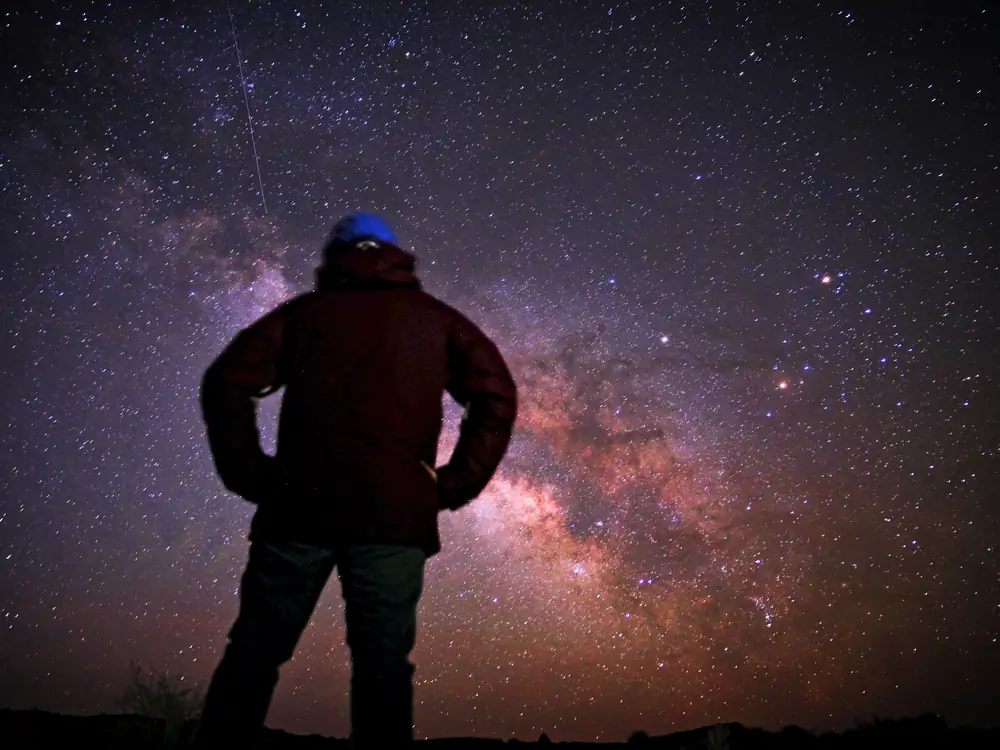
The night sky is the second reason to stay, and it is the one that surprises people. Goblin Valley State Park is a certified International Dark Sky Park, and the park brochure calls it one of the darkest night skies on Earth, virtually free of light pollution from populated areas. The Milky Way is visible on clear, moonless nights, and the hoodoos make a strong foreground for night photography. The park stays open until 10 pm for day visitors, so a late evening visit works even without a campsite, but campers get the full night. The Utah dark sky guide covers the other dark sky parks on the Mighty 5 route. Use a red headlamp, keep light levels low, and do not shine bright lights on the rock walls, because the dark is the point of the place.
Best Time to Visit Goblin Valley
Spring and autumn are the best times to visit Goblin Valley State Park, and the park brochure says so plainly. March through May and September through October bring mild days and cool nights, with comfortable walking and clear skies, and those are the months when the campground books up first. Summer is a different trip, with daytime temperatures that can reach over 100 degrees Fahrenheit, so the walking should happen in the early morning and the late evening, and the middle of the day should be driving time or shade time. Winter days are often mild, though nights can drop near zero, and late summer storms bring lightning and flash flood risk, so stay out of narrow canyons when storms are forecast. Our best time to visit guide compares the months across all five national parks.
Frequently Asked Questions
How much does it cost to enter Goblin Valley State Park?
The day-use fee is $20 per private vehicle, for up to eight people, and the pass is valid until 10 pm the day after purchase. Motorcycles, bicycles, and pedestrians pay $10 each, and commercial vehicles pay $5 per person. The America the Beautiful pass is not accepted, because Goblin Valley is a Utah state park and not a national park, while a Utah State Parks annual pass is accepted for entry.
How long should you spend at Goblin Valley State Park?
Two to three hours covers the park for most visitors, with one to two hours in the Valley of Goblins and about an hour for the Three Sisters and the Carmel Canyon loop. Add the Goblin’s Lair hike and the stop becomes half a day, and add a night at the campground and the stop becomes a full dark sky experience. The park is open from 6 am to 10 pm, so both an early morning visit and a late evening visit are possible on the same driving day.
Can you camp at Goblin Valley State Park?
Yes, the park has a 24-site campground, a group site, and two yurts, all bookable up to four months in advance through ReserveAmerica at 1-800-322-3770. A standard site costs $45 per night and includes park entry for one vehicle, with no electrical hookups, and the yurts cost $150 per night plus tax. Sites have shade shelters, picnic tables, and fire rings, with restrooms and showers nearby, and quiet hours run from 10 pm to 7 am.
Are dogs allowed at Goblin Valley State Park?
Yes, dogs are allowed, and the park lists pets among its amenities. Pets must be under control at all times on a leash no longer than six feet, and owners must clean up promptly after them. Up to two dogs are allowed in a yurt for an extra $20 each. This is a real difference from the national parks, where dogs are kept off the hiking trails entirely. Drones need a $15 permit per drone, and the goblins themselves are fragile, so climbing on the hoodoos is prohibited.
The Bottom Line
Goblin Valley State Park earns its place on the Mighty 5 route by being the one stop that breaks the pattern. Every national park on the route asks visitors to look at a landscape from a trail or an overlook, and Goblin Valley asks them to walk into it. Two or three hours, $20, and a short detour off Utah Highway 24 buys a valley of stone goblins, a short canyon walk, and, for those who stay the night, one of the darkest skies in the country. That is the whole case for the detour, and it is enough.
Start with our one day in Capitol Reef guide for the park before this stop, read our Canyonlands Needles District guide for the park after Moab, and fit the whole route together with our 7-day Mighty 5 itinerary. One detour, two hours among the goblins, and the strangest landscape on the drive. Our Utah national parks packing list covers the desert kit for the whole trip.