
Zion in Winter: The Quietest Season in Utah’s Busiest Park
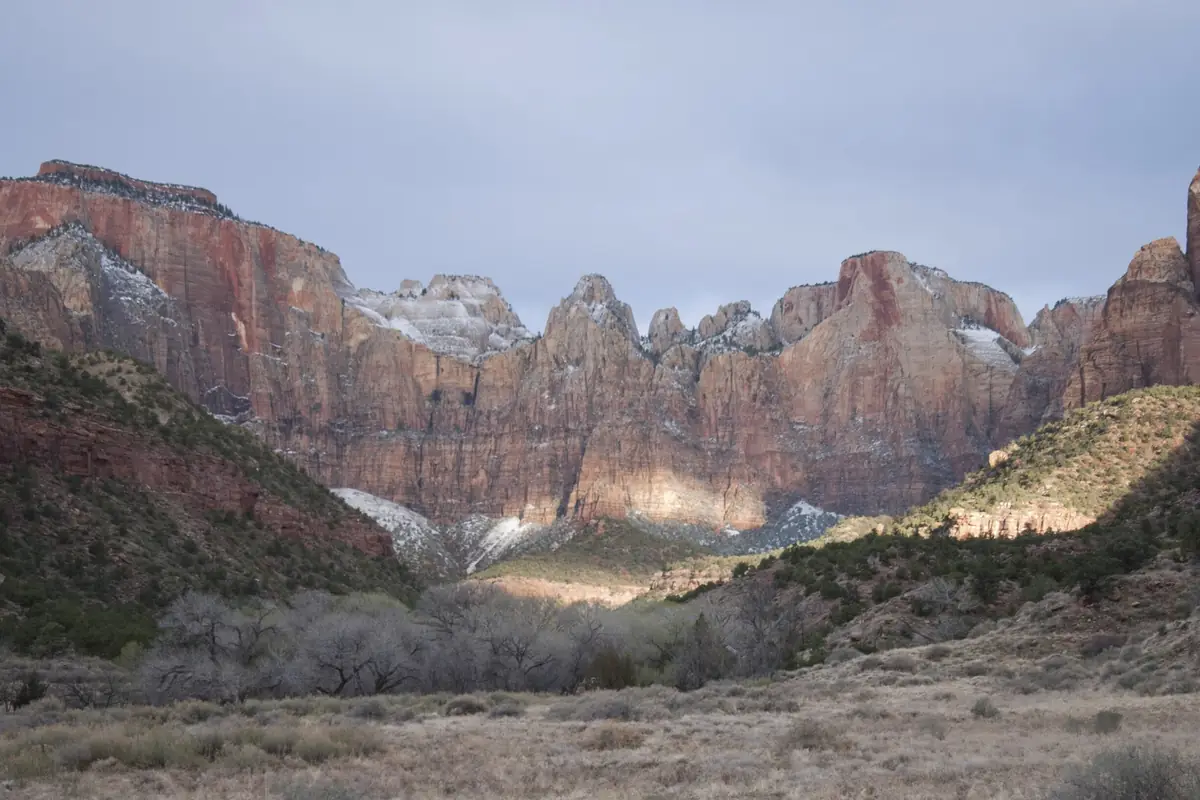

Zion in winter is a different park from the one most visitors know, and the difference is the whole point of going. The shuttle stops running for most of the season, so the six-mile Zion Canyon Scenic Drive opens to private cars for the only time of year. The trails empty out, the low sun turns the walls deep orange, and a dusting of snow makes the red rock look brand new. The price is real cold in the mornings, ice on the shaded trails, and days that end before five in the afternoon.
This guide covers the season honestly, with the dates that matter and the closures that are live right now. It explains when the shuttle runs and when it does not, which trails still work in the cold, what the Narrows and Angels Landing demand in winter, and where to sleep when the park goes quiet. Our one day in Zion guide covers the same canyon in the busy season, and our best time to visit guide compares winter with the other months across all five parks.
The Short Answer: Is Zion Worth Visiting in Winter?
Yes, if the quiet matters more to you than the warmth. Zion in winter trades the summer crowds for cold mornings, short days, and ice on the higher trails, and in return it gives you the canyon almost to yourself. You can drive the Scenic Drive in your own car, park at trailheads that are full by nine in the morning in June, and watch the first light hit snow-dusted towers without another person in the frame. The canyon floor rarely holds snow for long, so the walking stays possible most days, and the viewpoints are at their photographic best in the low winter light.
Skip winter if the trip depends on two specific hikes. The Narrows was closed at the last check in November 2026, with no reopening date posted, and Angels Landing turns genuinely dangerous when the chains ice over. If those two hikes are the reason for the trip, come in spring or autumn instead. For everyone else, winter is the easiest season to enjoy Zion on its own terms.
Zion in Winter at a Glance
|
Month |
Average high |
Average low |
Snow |
Shuttle |
Crowds |
|---|---|---|---|---|---|
|
December |
54 F |
30 F |
Light dustings, melts fast |
None Nov 29 to Dec 25, holiday shuttle Dec 26 to Jan 2 |
Quiet, busy Dec 26 to Jan 2 |
|
January |
54 F |
30 F |
Light dustings, melts fast |
None after Jan 2 |
The quietest month |
|
February |
59 F |
34 F |
Light dustings, melts fast |
None |
Quiet, warming up |
The temperatures come from the National Park Service climate chart for Zion Canyon, and they surprise most first-time winter visitors. Afternoons in the low to mid 50s feel pleasant in the sun, and the cold arrives in the mornings and after sunset, when the lows sit right around freezing. December averages about 18 nights below freezing, January about 20, and February about 13. Snow at canyon level is light, roughly four inches in a normal year, and it usually melts by midday.
Daylight is the real limit on a winter day. Around the shortest day of the year, the sun rises near 7:42 in the morning and sets near 5:18 in the evening, which leaves about nine and a half hours of light. The canyon walls steal some of that, because the sun leaves the canyon floor well before the published sunset time. Plan the longest hike for the middle of the day, and keep the mornings for the drive and the viewpoints.
The Shuttle Calendar: Three Different Winters
The shuttle is the first thing to understand about zion in winter, because the calendar splits the season into three different trips. From late November the shuttles stop and you drive the Zion Canyon Scenic Drive yourself. From December 26 to January 2 a holiday shuttle runs and the road closes to cars again. From January 3 the road is yours to drive until the spring shuttle starts, which in most years is in early March. The National Park Service posts the schedule on its shuttle page every season, and the dates below are the published 2026 to 2027 dates, checked on 21 November 2026.
|
Dates |
Shuttle |
Driving the Scenic Drive |
First and last shuttle |
|---|---|---|---|
|
Oct 25 to Nov 28, 2026 |
Running |
Closed to private cars |
First 7:00 am, last up 5:00 pm, last out 6:15 pm |
|
Nov 29 to Dec 25, 2026 |
No service |
Open to private cars |
No service |
|
Dec 26, 2026 to Jan 2, 2027 |
Holiday shuttle |
Closed to private cars |
First 8:00 am, last up 4:30 pm, last out 5:45 pm |
|
Jan 3, 2027 to spring |
No service |
Open to private cars |
No service |
The shuttle is free to ride, and no ticket or reservation is needed at any time of year. During the shuttle season, private vehicles cannot use the Scenic Drive at all, including before the first bus and after the last one. The drive from the visitor center to the Temple of Sinawava takes about 45 minutes each way, so a round trip is about an hour and a half. The Springdale town shuttle follows the same calendar, so the town line also stops from November 29 to December 25 and runs a holiday schedule from December 26 to January 2.
The holiday week is the exception that catches people out. The park is busy between Christmas and New Year, the shuttles return, and the Scenic Drive goes back to its summer rule, closed to private cars. The first bus leaves the visitor center at 8:00 in the morning, and the last bus up leaves at 4:30 in the afternoon. A winter Angels Landing permit has no time slot, so the 8:00 first bus sets the earliest possible start at the Grotto that week.
Driving the canyon yourself is the main reward of the quiet weeks, and it comes with one catch that the park states plainly. When the Scenic Drive is open to cars and the parking fills, the park closes the road for the day, and the park says that happens often in December, January, and February. The visitor center lot holds over 350 spaces, and the lots up the canyon are much smaller. Arrive early, park once, and walk or bike between the stops rather than driving from lot to lot.
What Winter Feels Like in Zion Canyon
Winter in the canyon is cold and often wet, in the Park Service’s own words, and the weather changes fast between the canyon floor and the high country. Zion Canyon sits near 4,000 feet, while the surrounding plateaus rise above 7,000 feet, so one visit can include dry sandstone, shaded ice, and deep snow within a few miles. A single storm can drop eight inches of snow in a day in December or February, and twelve and a half inches in January.
The cold is manageable with the right layers, and the sun does real work even in January. Daytime highs average 54 degrees in December and January and 59 in February, and a sunny afternoon on a south-facing trail can feel warm enough for a single layer. The mornings are the hard part, with lows around 30 degrees, and the shade stays cold all day in the narrow parts of the canyon. The dry air dehydrates quietly even in the cold, so the water and layers on our Utah national parks packing list earn their place here as much as anywhere else on a Mighty 5 trip.
What Is Open and What Is Closed in Winter
The park itself never closes. Zion is open 24 hours a day, every day of the year, including Christmas Day and New Year’s Day, and the entrance fee is the same $35 per private vehicle in winter as in summer. What changes is everything around the edges, and the closures below were live on the Park Service conditions page and alerts list at the last check on 21 November 2026. Closures change without much warning, so check the conditions page the night before and the morning of any winter visit.
|
Place or service |
Winter status |
Good to know |
|---|---|---|
|
Zion Canyon Scenic Drive |
Open to cars Nov 29 to Dec 25 and from Jan 3 |
Closes for the day when parking fills; shuttle only Dec 26 to Jan 2 |
|
Zion Canyon Visitor Center |
Open daily, 8:00 am to 5:00 pm |
Information desk and wilderness desk; park store open to 7:00 pm |
|
Zion Human History Museum |
Open daily, 10:00 am to 5:00 pm |
Good stargazing patio behind the museum |
|
Kolob Canyons Visitor Center |
Open 8:00 am to noon, 1:00 to 5:00 pm |
Closed noon to 1:00 pm; wilderness desk closed until further notice |
|
Zion Lodge |
Open year-round |
Reduced services in winter; the only lodging inside the park |
|
Watchman Campground |
Open year-round |
Reservations required; book up to six months ahead |
|
South Campground |
Closed for winter |
Closes at the end of October |
|
The Narrows |
Closed at last check |
Alert posted 17 Nov 2026, no reopening date given |
|
Watchman Trail |
Closed pending repairs |
Alert posted 31 Aug 2026, still listed at last check |
|
Hidden Canyon |
Closed |
Closed by a rockfall on the East Rim Trail |
|
Observation Point |
Unreachable from Zion Canyon |
Reachable only by hiking from the east |
|
Kolob Terrace Road |
Closed for months in winter |
Seasonal closure begins at Maloney Hill |
|
Kolob Canyons Road |
Open between storms |
Closes frequently in winter weather |
|
Zion-Mt. Carmel Highway |
Open, with closures |
Sometimes closed by snow, ice, or rockfall |
The Narrows closure is the biggest single change for winter trip planning. The Park Service posted the closure on 17 November 2026, and the alert says the Narrows and all other slot canyons entering the Narrows are closed, with no reopening date. Do not plan a winter trip around wading the Narrows until the conditions page says it is open again. The Riverside Walk still runs to the mouth of the Narrows, so the canyon can be seen from dry ground.
The Watchman Trail closure is the one that surprises returning visitors most. The trail has been closed pending repairs since the Park Service posted the alert on 31 August 2026, and it was still listed as closed at the last check on 20 November 2026. The Pa’rus Trail leaves from the same area near the visitor center and is the gentle substitute, with open river views toward the Watchman peak. Hidden Canyon is closed by a large rockfall on the East Rim Trail, and Observation Point cannot be reached from Zion Canyon while that closure stands.
Driving the Canyon Yourself
Driving Zion Canyon in winter is simple in concept and fiddly in practice, and the fiddly parts are worth getting right. The Scenic Drive is six miles from Canyon Junction to the Temple of Sinawava, and it passes the Court of the Patriarchs, Zion Lodge, the Grotto, and Big Bend on the way. When the shuttles are not running, the road belongs to private cars, and the drive itself becomes the sightseeing.
Parking is the practical problem. The visitor center lot is the biggest in the park, with over 350 spaces, and it fills on busy winter days, especially in the holiday week and on sunny weekends. The lots up the canyon are far smaller, and the Canyon Overlook trailhead lot holds only a handful of cars. If a lot is full, do not invent a parking space on a shoulder or in a pullout, because the park closes the road when the legal spaces are gone. Arrive before nine in the morning.
The Zion-Mt. Carmel Highway deserves its own warning, because it behaves differently from the canyon road. The highway climbs out of the canyon through the tunnel and across the east side, where the elevation is higher and the snow lasts longer. The Park Service says the road is sometimes closed due to snow, ice, rockfall, or traffic congestion, and the ranger winter video warns that Highway 9 can stay icy, slushy, or snow-covered for several days after a storm has passed. Check the conditions page before crossing, and call 511 for Utah road conditions outside the park. Overnight tunnel closures were also in place from 16 November 2026 for fiber optic installation.
The Best Winter Hikes in Zion
Winter does not close most of Zion’s trails, it changes what they demand. The low trails along the river stay walkable most days, while the high trails ice over and stay icy for days after a storm. The Park Service winter video gives the rule for every hike below: even on warm days, the trails can be ice-covered, and traction devices are a must. Our easy hikes in Zion guide covers these trails in full for the other seasons, and winter changes the footing rather than the geography.
|
Trail |
Distance (round trip) |
Time |
Ice risk |
Best for |
|---|---|---|---|---|
|
Pa’rus Trail |
3.5 miles |
1.5 to 2 hours |
Low |
Families, dogs, bikes, strollers |
|
Riverside Walk |
2.2 miles |
1.5 hours |
Low to moderate |
The Narrows entrance, canyon walls |
|
Lower Emerald Pool |
1.2 miles |
1 hour |
Moderate |
Waterfalls, icicles, a short walk |
|
Middle and Upper Emerald Pools |
About 3 miles |
2 to 3 hours |
High near Upper Pool |
Quieter terraces, sheer cliffs |
|
Canyon Overlook Trail |
1 mile |
1 hour |
High on shaded ledges |
The biggest view for the least effort |
|
Timber Creek Overlook Trail |
1 mile |
30 minutes |
Moderate |
Kolob Canyons, a quiet viewpoint |
|
Angels Landing |
5.4 miles |
4 to 5 hours |
Very high on the chains |
Only on a dry day, with a permit |
|
The Narrows |
Closed at last check |
Not applicable |
Not applicable |
Check the conditions page first |
Pa’rus Trail: The Most Reliable Winter Walk
The Pa’rus Trail is the safest bet in the park in winter, and it is the walk to choose on the coldest morning or the day after a storm. It is a paved, mostly flat riverside path of about three and a half miles round trip from the visitor center, and it follows the Virgin River with the Watchman peak rising across the canyon. The pavement clears and dries faster than any dirt trail in the park, and the gentle grade suits strollers, wheelchairs, and anyone who wants a winter walk without ice underfoot. It is also the only trail in Zion where dogs are allowed, on a lead, and bicycles are welcome on it too.
The trail earns its place in a winter plan for a second reason. It sits below Canyon Junction, outside the Scenic Drive, so it stays open and reachable even on the days when the canyon road is closed to cars because the parking has filled. The river views are at their best in the low winter light, and the bare cottonwoods leave the cliffs fully visible. Walk it at sunset for the warm light on the Watchman.
Riverside Walk: To the Mouth of the Narrows
The Riverside Walk is the paved path from the Temple of Sinawava to the entrance of the Narrows, about 2.2 miles round trip, and it is the closest most winter visitors will get to the famous slot canyon while the Narrows is closed. The walk runs beside the Virgin River under hanging gardens and towering walls, and in winter the river runs low and clear, with bare cottonwoods and lightly frosted rock ledges along the banks. The trail is paved and mostly level, and it catches enough sun to clear faster than the shaded trails higher up.
The walk ends where the river becomes the trail, and that is where the winter plan stops for now. When the Narrows is open, wading it in winter means a dry suit, neoprene socks, boots, and a wooden hiking stick, all rented from an outfitter in Springdale, and water between 38 and 45 degrees. The Narrows closes whenever the river flow passes 150 cubic feet per second, so the river hike is a decision for the morning of the trip.

Emerald Pools: Waterfalls and Icicles
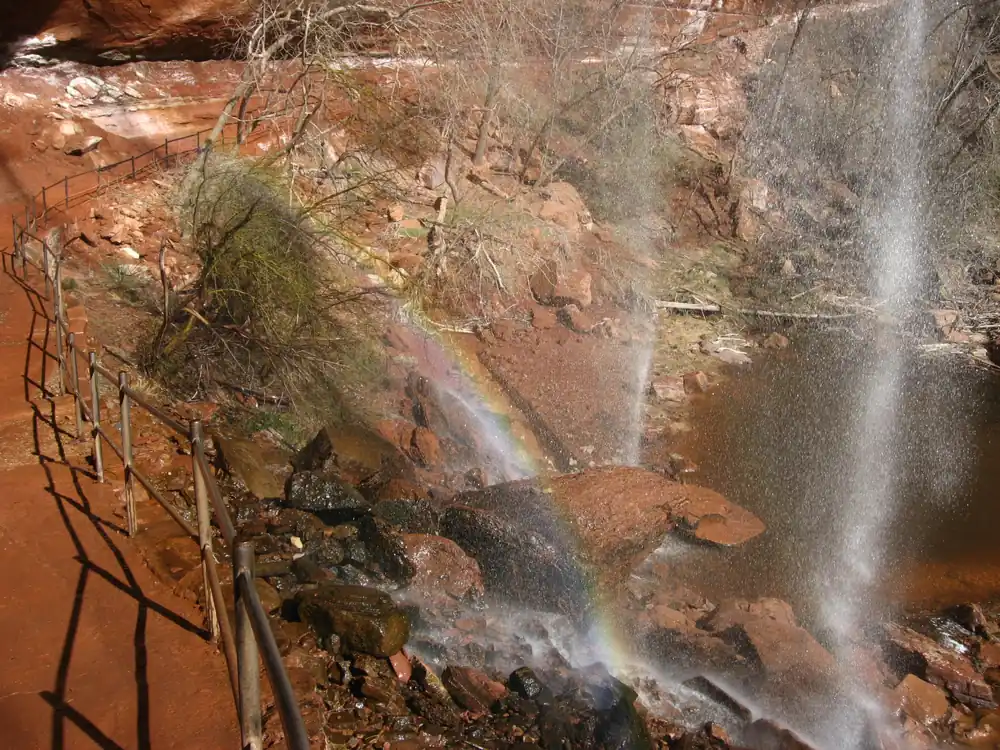
The Emerald Pools trails are the prettiest short walks in the canyon in winter, and they are also the ones where ice shows up first. The Lower Emerald Pool trail is a short paved walk of about 1.2 miles round trip from Zion Lodge, and it ends at a rock alcove where water drips from an overhang into a small pool. In a cold snap the drips turn to icicles, and the Park Service winter video names the Emerald Pools as one of the places to see waterfalls and icicles in the season. The footbridge over the river at Zion Lodge reopened in June 2025, so the pools are reached easily from the lodge side again.
The walk is short and the ground is paved, which makes it tempting to treat as an easy stroll, but the wet rock under the overhang freezes, and the shaded steps can stay icy for days. Carry traction devices even for this walk, and hold the railings on the steps. The Middle and Upper Emerald Pools continue uphill, and the higher trail holds ice near the Upper Pool, at the foot of a sheer cliff. The full loop runs about three miles, and it is the quieter half of the pools.
Canyon Overlook Trail: The Biggest View for the Least Effort
Canyon Overlook packs the biggest view in Zion into a one-mile round trip, and in winter it is both the best short hike and the one that needs the most respect. The trail starts just east of the Zion-Mt. Carmel Tunnel on Highway 9, crosses ledges and climbs about 163 feet to an overlook straight down Pine Creek Canyon into lower Zion Canyon, with the highway switchbacks far below. The walk takes about an hour, and the overlook is fenced, so it suits careful walkers who want a real viewpoint without a long climb. The trailhead lot is very small, so arrive early or try again later in the day.
The catch is the ice. Parts of the trail run along shaded ledges that freeze and stay frozen, and the sandstone turns slick where the sun never reaches it. Carry traction devices, wear them before the ledges start, and do not hurry the fenced sections. The east side holds snow longer than the canyon floor, so the trail can be icy even on a day when the main canyon is dry and warm.

Angels Landing in Winter: Only on a Dry Day
Angels Landing stays open in winter, and it is the one famous Zion hike where winter changes the risk rather than just the comfort. The chained section from Scout Lookout to the summit still needs a permit all year, and the Park Service describes the route as extremely dangerous during icy or snowy conditions. The chains ice over, the sandstone underfoot turns slick, and the exposure that makes the hike famous leaves no room for a slip. Go only on a dry day, with traction devices fitted before the chains start, and turn back if the chains are iced. The summit sits 1,488 feet above the canyon floor, and the view is the same in January as in June, but the margin for error is far smaller.
The permit system runs all winter, and the seasonal lottery for December 1 to February 28 closed on 20 October 2026, with permits issued on 25 October. The day-before lottery still runs through the winter, so a winter permit is possible without months of planning. Winter permits have no time slot, so during the holiday shuttle week the first bus at 8:00 in the morning sets the earliest start at the Grotto. Our Angels Landing permit guide explains the lotteries, the seasons, and the exact rules in full. If the chains are icy, Scout Lookout is the honest turnaround point, and the view from there is a fine winter hike on its own.

Beyond the Main Canyon: Kolob Canyons and the East Side
The main canyon gets the attention, but the quiet corners of Zion are where winter shows its best side. Kolob Canyons sits off Interstate 15, about 40 miles north of the main canyon, and it is the part of the park that most summer visitors skip entirely. The five-mile scenic drive climbs through finger canyons of brilliant red rock, and in winter the snow sits on the ledges while the road stays open between storms. The road closes frequently in winter weather, so check the conditions page before driving up. The Timber Creek Overlook Trail at the end of the road is a one-mile round trip, and it is the quietest viewpoint in the park in winter.

The Kolob Terrace Road is the other high road, and winter closes most of it for several months from fall to spring, with the seasonal closure beginning at Maloney Hill, about one mile east of the Hop Valley Trailhead. The Lava Point Road, which branches off it, is typically closed from fall into spring as well.
The east side of the park, past the tunnel on the Zion-Mt. Carmel Highway, holds snow longer than the main canyon and looks different for it. Checkerboard Mesa and Crazy Quilt Mesa show their crisscross patterns more clearly when snow highlights them.

After Dark: Long Nights and Dark Skies
Zion is a certified International Dark Sky Park, designated on 3 June 2021, and winter is the best season to use that designation. The nights are the longest of the year, the air is dry and usually clear, and the early sunset means the stars are out before dinner is finished. The winter constellations, Orion and the Pleiades, ride high over the canyon, and the Geminid meteor shower lights up the middle of December. One honest note belongs here, because it saves disappointment. The bright Milky Way core that fills summer photographs is not visible in November, December, or January, because the core sits below the horizon in the winter months. Winter stargazing is about the sharp winter stars, the planets, and the meteors, not the galactic core. The Park Service suggests two easy viewing spots: the Pa’rus Trail, a flat paved path from the visitor center, and the back patio of the Human History Museum, which looks out toward the Temples and Towers of the Virgin. Bring a red flashlight to protect night vision, and dress for ten degrees colder than the thermometer says. Our Utah dark sky guide covers the best stargazing nights across all five parks, and Zion is one of the two best parks on that list.
Where to Stay and Eat in Winter
Winter removes none of the beds in Zion, and that is one of the quiet advantages of the season. Zion Lodge is open year-round, with reduced services in winter, and it is the only lodging inside the park. Lodge guests can drive in during the holiday shuttle week, which is a real advantage between Christmas and New Year. Our where to stay near Zion guide covers the lodge, the Springdale hotels, and the campgrounds in full.
Springdale, the small town at the park’s South Entrance, is the base for almost every winter trip. The town is quieter in winter, and some restaurants and businesses keep shorter winter hours. Winter rates outside the holiday weeks are lower, which softens the numbers in our Utah Mighty 5 trip cost breakdown. Outfitters in Springdale stay open through the winter for dry suit rentals and traction devices.
Camping is the cheapest winter option and the coldest one. Watchman Campground is open year-round, and reservations are required. South Campground closes for the winter at the end of October, and Lava Point Campground closes seasonally as well, so Watchman is the only campground inside the park in winter. Nighttime lows sit around freezing, so winter camping in Zion needs a proper cold-weather sleeping setup, not a summer bag and good intentions.
Planning Your Visit: Fees, Water, and Safety
The planning for Zion in winter is simpler than for the other Mighty 5 parks in one way, because there is no timed-entry reservation and no advance ticket for general entry. The entrance fee is $35 per private vehicle, $20 per person on foot or bicycle, and the pass is valid for seven days. The $70 Zion Annual Pass covers the park for a year and is available to US citizens and residents only. The America the Beautiful pass is accepted, at $80 a year for US residents and $250 a year for nonresidents, and the current figures are on the NPS fees page. Non-US residents aged 16 and over should also check our nonresident fee guide, because Zion is one of the two Mighty 5 parks where an extra $100 per person surcharge applies, unless the visitor is admitted with an Annual or America the Beautiful pass.
Water is the planning item that visitors forget in winter, because cold weather hides thirst. There is no drinking water at any trailhead in the park, so fill every bottle at the visitor center or the lodge before hiking. The Virgin River is not drinking water, and the Park Service warns against submerging heads in or drinking instream water anywhere in the park, because of toxic cyanobacteria. Carry more water than seems necessary on the longer hikes. Cell service is poor or absent in much of the park, so download offline maps before leaving Springdale.
Flash floods are the one serious danger that winter does not remove. Never enter a slot canyon, a wash, or a canyon bottom if rain is forecast anywhere in the region, because a storm miles upstream can send water into a canyon with no warning at the trailhead. The Narrows closes whenever the river flow passes 150 cubic feet per second. Ice is the other danger, and the rule is simple: if a trail is iced and there are no traction devices, turn back.
Zion in Winter Checklist
- Check the NPS Current Conditions page and the NPS shuttle page before the trip, and check the visitor center board on arrival for closures and the weather.
- Match the trip dates to the shuttle calendar: no shuttle from November 29 to December 25 or from January 3, holiday shuttle from December 26 to January 2.
- Buy the $35 vehicle pass at the entrance station, or bring the America the Beautiful pass, and check the nonresident surcharge if it applies.
- Pack traction devices for every hiker, warm layers, waterproof boots, water, and a headlamp, and carry chains or winter tires for the car.
- Arrive before nine in the morning, park once, and walk or bike between the stops, because the Scenic Drive closes for the day when parking fills.
- Do not plan on the Narrows or the Watchman Trail until the conditions page says they are open again.
- Stay after dark on a clear night, and bring a red flashlight for stargazing on the Pa’rus Trail or the museum patio.
- Never enter a slot canyon or a wash if rain is forecast anywhere in the region, and turn back from any trail that is iced beyond the traction devices.
Frequently Asked Questions
Is Zion open in winter?
Yes, Zion is open 24 hours a day, every day of the year, including Christmas Day and New Year’s Day. Winter weather does not close the park, but it changes which roads, trails, and services can be used on a given day. The visitor center is open daily from 8:00 in the morning to 5:00 in the afternoon, and the entrance fee is the same $35 per private vehicle as in summer.
Can I drive Zion Canyon Scenic Drive in winter?
Yes, for most of the winter, and it is the main reason to go now. The shuttles stop from November 29 to December 25 and again from January 3 until the spring shuttle starts, and during those stretches private cars can drive the six-mile Scenic Drive. The road closes to cars again from December 26 to January 2, when the holiday shuttle runs. If the parking fills while the road is open to cars, the park closes the road for the day, so arrive early.
How cold does Zion get in winter?
Daytime highs average 54 degrees in December and January and 59 degrees in February, and nighttime lows average around 30 degrees in December and January and 34 degrees in February. December averages about 18 nights below freezing, and January about 20. The higher ground is much colder than the canyon floor, so dress for the morning cold and carry layers for the sunny afternoon.
Is the Narrows open in winter?
Not at the last check. The Park Service posted a closure alert on 17 November 2026, closing the Narrows and all other slot canyons entering it, with no reopening date given. When the Narrows is open in winter, it needs a dry suit rented from an outfitter in Springdale, because the water runs between 38 and 45 degrees, and it closes whenever the river flow passes 150 cubic feet per second. Check the conditions page before planning around it.
Do I need a permit for Angels Landing in winter?
Yes, a permit is required all year for the chained section from Scout Lookout to the summit, and winter is no exception. The seasonal lottery for December 1 to February 28 closed on 20 October 2026, and the day-before lottery runs through the winter. Winter permits have no time slot. The Park Service calls the route extremely dangerous in icy or snowy conditions, so go only on a dry day with traction devices, and turn back if the chains are iced.
How much is the Zion entrance fee in winter?
The entrance fee is $35 per private vehicle and $20 per person on foot or bicycle, and the pass is valid for seven days. The fee is the same in winter as in summer. Non-US residents aged 16 and over pay an extra $100 per person unless admitted with an Annual or America the Beautiful pass, and the America the Beautiful pass costs $80 a year for US residents and $250 a year for nonresidents.
The Bottom Line
Zion in winter is the quietest version of Utah’s busiest park, and the season rewards the visitors who plan around its calendar. The shuttle stops, the road opens to private cars, the trails empty, and the low sun turns the canyon into the best light of the year. The cold mornings, the short days, and the ice on the shaded trails are the price, and the price is fair. Dress warmly, carry traction, arrive early, and check the conditions page before every drive into the canyon.
Start with our one day in Zion guide for the full canyon plan in the busy season. Then read our Zion vs Bryce guide if the trip has room for a second park, and fit Zion into the bigger loop with our 7-day Mighty 5 itinerary.