Canyonlands in Winter: What to Expect in Island in the Sky and the Needles
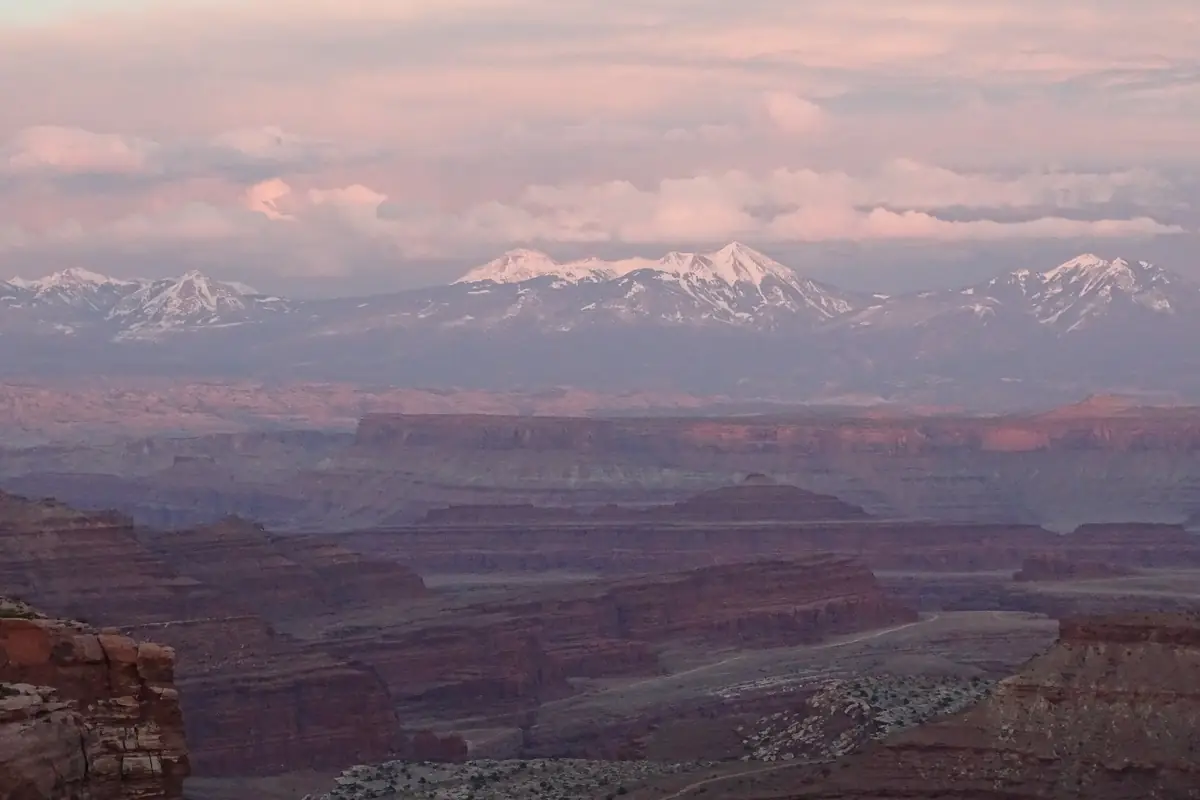
Canyonlands in winter is the quietest version of Utah’s biggest national park, and the quiet comes with a trade, because the same season that empties the roads also closes one visitor center, shortens the daylight, and ices the shaded trails. This guide covers the season as the National Park Service describes it, checked on 22 November 2026, with temperatures, daylight, hours, and road warnings taken from the Park Service pages listed in FACTS.md. What follows is an honest editorial guide, not a personal trip report, and every closure and condition should be re-checked the night before a winter visit, because winter conditions change with a single storm.
The Short Answer: Is Canyonlands Worth Visiting in Winter?
Yes, for visitors who are self-reliant and who choose the right district, and most clearly for visitors whose winter plan is Island in the Sky. The mesa-top district has a paved road, an open visitor center, water when that center is open, and a string of overlooks that need no long hiking at all. The Needles is worth a winter day too, but only for hikers who carry their own water and accept that the visitor center will be closed for most of the season.
Skip winter only if the trip depends on ranger help close at hand, on the Needles visitor center, or on warm weather for long hikes. Visitors who want the full three-district park, the Maze included, should wait for a dry spring or fall trip, when every visitor center is open and the backcountry roads are at their best.
Canyonlands in Winter at a Glance
|
Month |
Average high |
Average low |
Days below freezing |
Snow and ice |
Crowds |
|---|---|---|---|---|---|
|
December |
45 F |
23 F |
26 |
Light snow, ice in shade |
Very quiet, busier around Christmas |
|
January |
44 F |
22 F |
28 |
Light snow, ice in shade |
The quietest month |
|
February |
52 F |
28 F |
22 |
Light snow, ice in shade |
Quiet, warming up |
The temperatures come from the National Park Service weather almanac for Canyonlands, and the Park Service summarises the season more broadly as highs averaging 30 to 50 degrees and lows averaging 0 to 20 degrees. The almanac averages hide the coldest nights, because December has dropped to 5 degrees and January to minus 1 degree, and the lows on the exposed mesa top can feel colder still when the wind runs across it. Large snowfalls are uncommon in the park itself, except in the nearby mountains, and the Park Service warns plainly that even small amounts of snow or ice can make local trails and roads impassable. The danger in this park is rarely deep snow, and it is almost always ice on shaded slickrock, snow covering the cairns that mark a trail, and a paved road closed for a few hours while crews plow. For how winter fits the full year, see our best time to visit Utah’s national parks guide.
Daylight is the real limit on a winter day. Around the shortest day of the year, near 21 December, Moab gets about nine and a half hours of daylight, with sunrise near half past seven and sunset near five in the afternoon, and the earliest sunsets arrive around the start of December, at about five minutes to five. By the end of January the days have lengthened by roughly an hour, and February adds nearly another hour on top of that, so a late-winter trip has noticeably more hiking time than a December one. Plan every hike backward from sunset, because the mesa-top road is unlit, the shaded stretches ice first after dark, and a slow return in fading light is the most common winter mistake.
What Winter Feels Like at Canyonlands
Winter in this park is cold, dry, and changeable, and the elevation explains why it feels colder than most visitors expect from southern Utah. Southeast Utah is high desert country, where the temperature can swing more than 40 degrees in a single day, and Canyonlands runs from about 3,900 feet along the rivers to more than 7,000 feet on the high ground in the Needles. The Island in the Sky weather station sits at 5,930 feet and the Needles station at 5,040 feet, so the mesa top runs colder and windier than the town of Moab below it. Dress for wind as well as cold, because the mesa top is open country with no shelter, and a 45-degree afternoon can feel far colder once the wind runs across it.

Driving in Winter: Paved Roads, Dirt Roads, and Chains
Driving is how most winter visitors see Canyonlands, and the paved roads are the simplest part of the season. There is no shuttle system in the park, so visitors drive themselves all year, and winter changes nothing except the road surface after a storm. The Island in the Sky Scenic Drive is paved all the way to Grand View Point, the Needles is reached by the paved UT 211, and both paved roads may close temporarily after snow while crews plow, then reopen the same day in most cases. Check the Utah road conditions line or the state traffic site for the highways outside the park before setting out, because the Park Service says paved-road closures are usually measured in hours while unpaved roads may be impassable for longer.
The unpaved roads are a different matter, and winter makes them worse in ways a paved-road visitor never sees. Rain and snow can quickly change an unpaved road to four-wheel-drive condition or make it impassable, in the Park Service’s own words, and chains are advised for all four tires from October through April on the backcountry roads. The Shafer Trail, the White Rim Road, Elephant Hill, and every road into the Maze need a high-clearance four-wheel-drive vehicle with a low-range gear, and the White Rim Road and Elephant Hill also need a day-use permit, so none of them belongs in a winter plan built around a rental sedan. At the NPS road update of 19 November 2026 for Island in the Sky and 12 November 2026 for the Needles, the Shafer Trail was open with high-clearance four-wheel drive recommended, the White Rim Road was open but travel was not advised on its west side because of mud and quicksand, Mineral Bottom and the west side of the White Rim remained muddy and travel was not recommended until they dried out, and several Needles backcountry roads were impassable after recent rains. Treat a November status as history, not as a promise, and check the live road conditions page the night before and the morning of any drive.
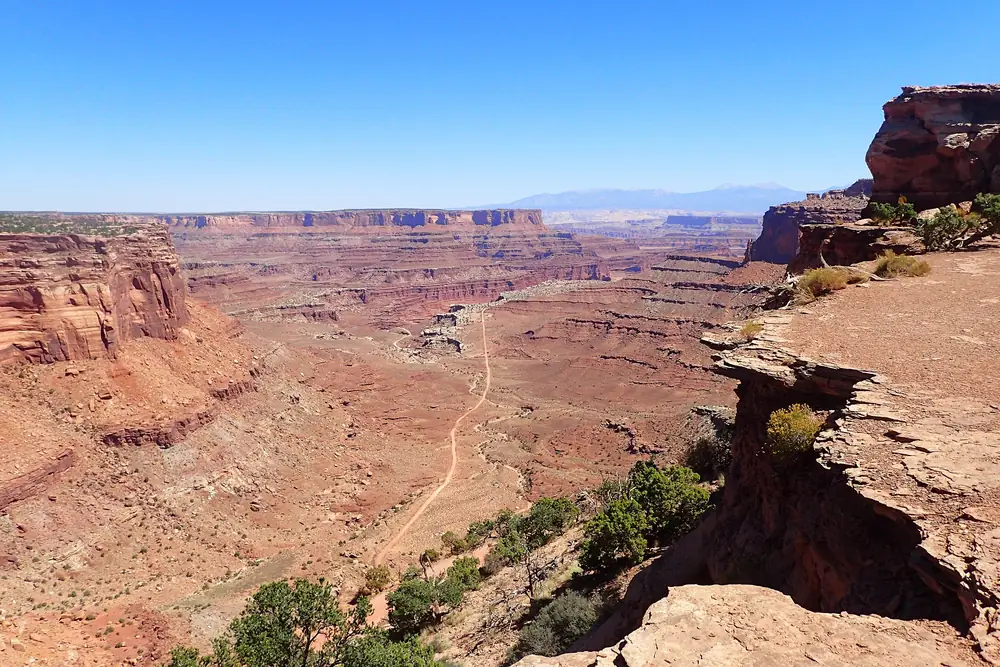
Parking is rarely the problem it is in the busy season, because the Park Service notes that the long entrance lines and full trailhead lots run from March to November, and December through February sits outside all of that. The Mesa Arch trailhead lot is the one exception, because sunrise photographers still arrive before dawn even in winter, and the White Rim Overlook trailhead lot is very small at any time of year. If a lot is full, do not park on vegetation or block the road, because the fragile desert surface does not recover from tire tracks, and wait for a space or come back later in the day. For the car itself, the winter kit starts with chains, a full tank, and a charged phone, because cell service is limited in some areas of the park and nonexistent in many others, and the Park Service says plainly not to count on being able to receive service. Keep the fuel tank at least half full, carry a scraper, a shovel, and blankets, and allow extra time for every drive after a storm.
What Is Open and What Is Closed in Winter
The park itself never closes. Canyonlands is generally open year-round, 24 hours a day, and the entrance fee applies at all hours, and the Park Service answers the question directly in its FAQ, saying the park never closes and calling it a great place for stargazing. What changes in winter is everything around the edges, and the change is uneven, because one visitor center stays open all winter, one closes for more than two months, and the third keeps its own shorter hours. The table below gives the winter position as published by the Park Service, checked on 22 November 2026, with the winter page last updated on 21 September 2026. Check the winter page and the conditions page the night before and the morning of any winter visit, because the hours below are the published 2026 to 2027 dates and the Park Service revises them each season.
|
Place or service |
Winter status |
Good to know |
|---|---|---|
|
Park, 24 hours |
Open year-round |
No timed-entry reservation |
|
Island in the Sky Visitor Center |
Open 7 days a week; 8 am to 4 pm to 29 Nov, then 9 am to 4 pm to 2 Mar |
Closes 1 pm Thanksgiving and Christmas Eve; closed Christmas Day |
|
Needles Visitor Center |
Open 8 am to 4 pm to 6 Dec; CLOSED 6 Dec to 12 Feb; reopens 13 Feb 2027 |
No water in the district while it is closed; rangers still on duty |
|
Hans Flat Ranger Station (Maze) |
Open daily 8 am to 4 pm in winter |
No water, gas, food, or lodging in the Maze |
|
Paved scenic roads |
Open between storms; temporary closures for plowing |
Check road conditions page before driving |
|
Unpaved backcountry roads |
Often 4WD only or impassable after snow |
Chains advised Oct to Apr; permits on White Rim and Elephant Hill |
|
Ranger programs |
None listed for winter |
Evening programs at the Needles run spring and fall only |
|
Campgrounds |
Open year-round, first-come, first-served in winter |
Willow Flat no water; Needles campground has no water in winter |
|
Hiking trails |
Most remain open year-round |
Ice on shaded slickrock; traction aids recommended |
|
Food, gas, lodging in the park |
None |
Aside from visitor centers and toilets, no facilities |
|
Entrance fee |
$30 per private vehicle, valid 7 days |
No $100 nonresident surcharge at Canyonlands |
The visitor-center hours deserve a careful read, because two Park Service pages do not quite agree about deep winter at Island in the Sky. The dedicated winter page, updated in September 2026, says the Island in the Sky visitor center will be open seven days a week, 9 am to 4 pm daily from 30 November through 2 March, while the older FAQ page says that between early January and early March the same center is open Friday through Tuesday and closed on Wednesdays and Thursdays. This guide follows the newer, winter-specific page, and the publish-day check must confirm which pattern is actually in force, because arriving on a Wednesday in January to a closed visitor center changes the water plan for the whole day.
Water is the planning item that the visitor-center hours control, and winter makes it stricter than in any other season. At Island in the Sky, water may be available at the visitor center only when the visitor center is open, and there is no water in the Willow Flat campground, so a visitor who arrives after four in the afternoon has no water source in the district until the center opens again. At the Needles, water is available only at the visitor center, there is no water at the campground, and the Park Service recommends bringing all the water needed for the visit, which becomes a firm rule during the two-month closure. In the Maze there is no water at all, in any season, so fill every bottle in Moab or Monticello before entering the park, carry more than seems necessary on every hike, and follow the Park Service guidance of at least one quart per person for short trails and up to a gallon for long trails.
Island in the Sky in Winter: The Mesa-Top Day
Island in the Sky is the district to visit first in winter, and it is the easiest district in Canyonlands to love in a single cold day. A flat-topped mesa rises more than 1,000 feet above the desert floor, with the Green and Colorado Rivers carving canyons around three sides of it, and one paved road runs out along the top to a string of overlooks. The visitor center sits 32 miles from Moab, about a 40-minute drive on Utah 313, and the scenic road runs 34 miles round trip to Grand View Point and back. The district holds about three quarters of the park’s visitors in a normal year, which still leaves it quiet in winter, and it is the only district with a visitor center open all winter, water when that center is open, and a paved road that crews plow after snow. Canyonlands in winter is at its simplest here, and a first-time winter visitor should start here before judging whether the Needles suits the trip at all.
Sunrise at Mesa Arch: The Famous Morning, Without the Crowd
Mesa Arch is the reason to set an alarm, and winter makes the alarm almost civilised. The trail is a gentle 0.6 mile loop that takes about 30 minutes, and it ends at a slender sandstone arch perched right on the cliff edge, framing the La Sal Mountains and roughly 1,200 feet of canyon below. At sunrise the first light strikes the cliff face far below the arch in Buck Canyon and bounces upward, and for about fifteen minutes the reflected light fires the underside of the arch orange while the canyon behind it stays in shadow. The arch is a pothole arch, 27 feet long, and the Park Service calls it a classic sunrise spot that is popular among photographers, which is why the trailhead fills before dawn in spring and fall and why winter, with its late sunrise after half past seven, is the season to see it without the crowd.
Winter changes the morning in two practical ways, and both of them are about footing and position rather than about the light itself. The sun rises to the south in winter, to the right of the arch as it is viewed from the trail, so photographers should expect the sun to appear to the right rather than in line with the opening. The slickrock steps on the short trail can ice over, and the rim can hold snow, so arrive 45 to 60 minutes before sunrise with a headlamp and wear traction aids before the icy sections start. Our Mesa Arch at sunrise guide covers the timing, the parking, and the etiquette in full, and do not climb or stand on the arch, because the park prohibits climbing, scrambling, walking, or standing upon any arch.

The Overlooks and Short Trails Along the Scenic Drive
Back on the road, the next stops come quickly, and they all share one idea, which is looking down into the canyon system from the rim. Grand View Point is the highest viewpoint on the mesa, with a panorama that takes in the White Rim bench, the Needles in the distance, and the La Sal Mountains beyond, and the short paved path from the parking area gives the full view without a hike. The NPS conditions page still lists a Grand View Point remodel for late summer to early fall in 2024, 2025, and 2026, so check the conditions page before visiting in case work affects access. Shafer Canyon Overlook looks down on the Shafer Trail switchbacks as they drop roughly 1,500 feet toward the White Rim, and the view explains at a glance why that dirt road needs a high-clearance four-wheel-drive vehicle. Green River Overlook faces west and takes the sunset, while Buck Canyon Overlook and Orange Cliffs Overlook fill the drive south, and each one is a short walk from the car, which matters on a cold day.
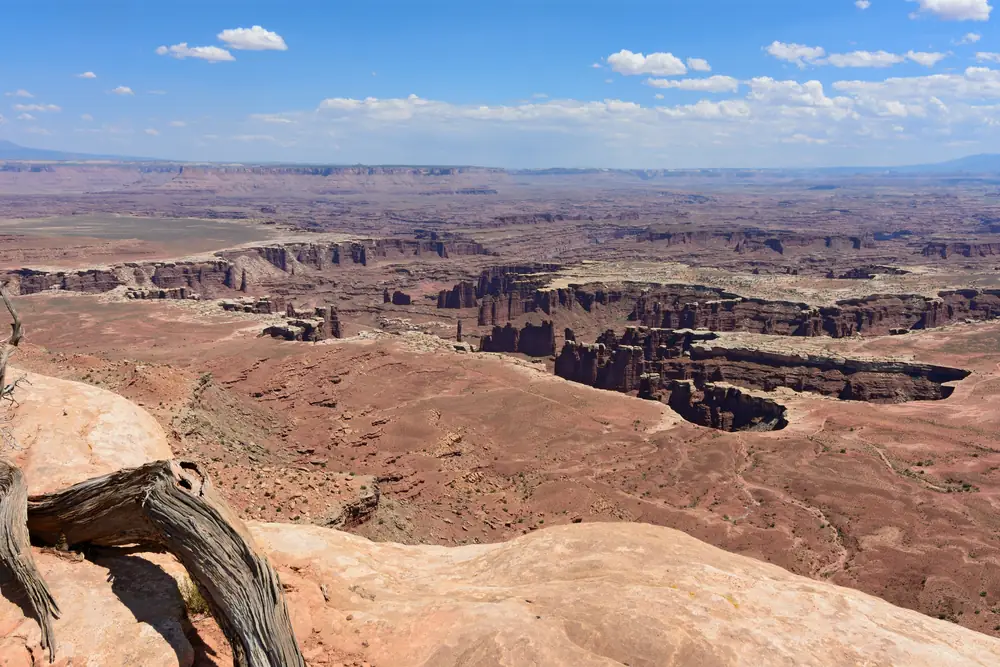
The short trails are where winter shows its footing most clearly, and the Park Service trail list gives the distances that a winter plan should work from. Grand View Point is the best walk on the mesa, a 1.8 mile out-and-back that follows the canyon edge for about an hour and a half, while the viewpoint at the parking area gives much of the same view for no walking at all. White Rim Overlook is the prettier walk, a 1.8 mile trail to an east-facing overlook above the Colorado River, Monument Basin, and the La Sal Mountains, which the park calls best in late afternoon, but its trailhead lot is very small. Upheaval Dome is the strangest stop on the mesa, a short but steep 0.6 mile trail with 100 feet of climbing to the first overlook above a circular bowl of fractured rock about three miles across, where the exhibits lay out the two theories, a rising salt layer or a meteorite strike, and recent research supports the impact theory. Whale Rock climbs a sandstone dome in 0.8 miles with steep drop-offs, Aztec Butte scrambles over slickrock in 1.4 miles to ancestral Puebloan structures that must be viewed from a distance and never entered or touched, and Murphy Point walks 3.4 miles past a historic corral to views of Candlestick Tower and the Green River. Our one day in Island in the Sky guide lays out the mesa-top day in a timed plan, with the stops in the order that works best.
|
Trail |
Distance (round trip) |
Time |
Ice risk |
Best for |
|---|---|---|---|---|
|
Mesa Arch |
0.6 miles |
30 minutes |
Moderate on slickrock steps |
Sunrise, the classic photograph |
|
Grand View Point |
1.8 miles |
1.5 hours |
Moderate on the rim, high in wind |
The full panorama, end of the road |
|
White Rim Overlook |
1.8 miles |
1.5 hours |
Low to moderate |
Late afternoon, Colorado River views |
|
Upheaval Dome, first overlook |
0.6 miles |
30 minutes |
Moderate on the steep climb |
The crater mystery, a quick climb |
|
Whale Rock |
0.8 miles |
1 hour |
Moderate, steep drop-offs |
Empty slickrock and broad views |
|
Aztec Butte |
1.4 miles |
1.5 hours |
High on slickrock scrambles |
A scramble and ancient granaries |
|
Murphy Point |
3.4 miles |
2 hours |
Low to moderate |
Quiet, a historic corral, the Green River |
Skip the long mesa-top descents in winter unless the day is dry, the party is experienced, and the return climb is planned with daylight to spare. The Syncline Loop runs 8.1 miles in five to seven hours around Upheaval Dome, drops 1,300 feet through steep switchbacks and boulder fields, and the Park Service notes that most park rescues occur on that trail, which is a warning that winter ice only sharpens. The long trails that descend from the mesa top are all strenuous, with 1,000 to 2,000 feet of elevation change over loose rock and deep sand, and a descent that feels easy in the morning becomes a long, cold climb back to the rim in the afternoon.
The Needles in Winter: A Hiking District Without Its Visitor Center
The Needles in winter is a different trip from Island in the Sky, and the difference starts before the park boundary, on the long drive in. From Moab, drive 40 miles south on US 191, then turn west onto UT 211 and follow it roughly 35 miles to the park, for a total of about 75 miles and roughly an hour and a half of driving, and UT 211 is the only paved road leading in and out of the area. The Park Service strongly recommends using a map to reach the Needles, because GPS units frequently lead people astray on the back roads of San Juan County, so download the route offline before leaving town, since cell service is extremely limited throughout the district. Fill the gas tank in Moab or Monticello, because there is no gas in the park, and fill every water bottle before leaving town as well, because during the visitor-center closure there is no water source in the district at all.
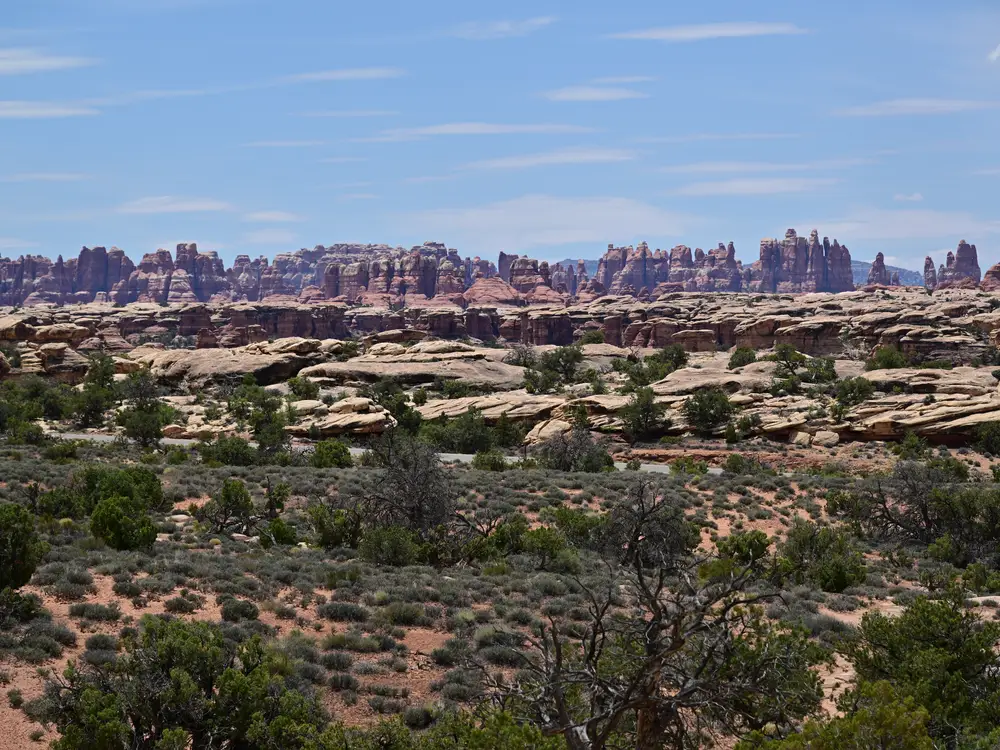
Canyonlands in winter rewards the Needles visitor who arrives self-reliant and punishes the visitor who expects the summer setup to still be there. The visitor center is closed from 6 December through 12 February, which removes the exhibits, the book and map sales, the backcountry permits desk, and the only water source in the district in one stroke, and the evening ranger programs at the campground do not run in winter at all. The scenic drive, the short trails, and the long hikes all remain, and the spires that give the district its name, the colorful spires of Cedar Mesa Sandstone, look no less striking under a winter sky, but there is no one at the district to ask about ice, closures, or road damage on the day. Check the conditions page and the road conditions page before the drive, carry a topographic map, and treat the district as a backcountry day even when the plan is only a short walk.
Short Trails: The Honest Winter Core of the Needles
Walk the four short trails along the scenic drive first, because each one shows a different side of the district and each one stays manageable when the long hikes turn icy. The trails are marked with cairns, and the surfaces can be uneven, so wear real hiking shoes even for the short ones, and carry traction aids, because the Park Service winter guidance says sandstone covered with snow and ice is treacherous and snow can quickly cover cairns. Cave Spring is the most interesting of the four, a 0.6 mile loop in about 45 minutes to a historic cowboy camp and to prehistoric rock paintings and peckings, with two ladders to climb to complete the route, and the ladders deserve a second look on an icy morning. Pothole Point is the quietest of the four, a 0.6 mile walk over uneven slickrock in about 40 minutes, the Slickrock Trail is the longest of the short trails, at 2.4 miles in about two hours with expansive 360-degree views, and Stone Storehouse is the shortest, at 0.3 miles in about 20 minutes to a storage structure built by Indigenous people, which must never be entered, touched, or climbed on.
Chesler Park, the Joint Trail, and Druid Arch: Long Hikes, Winter Rules
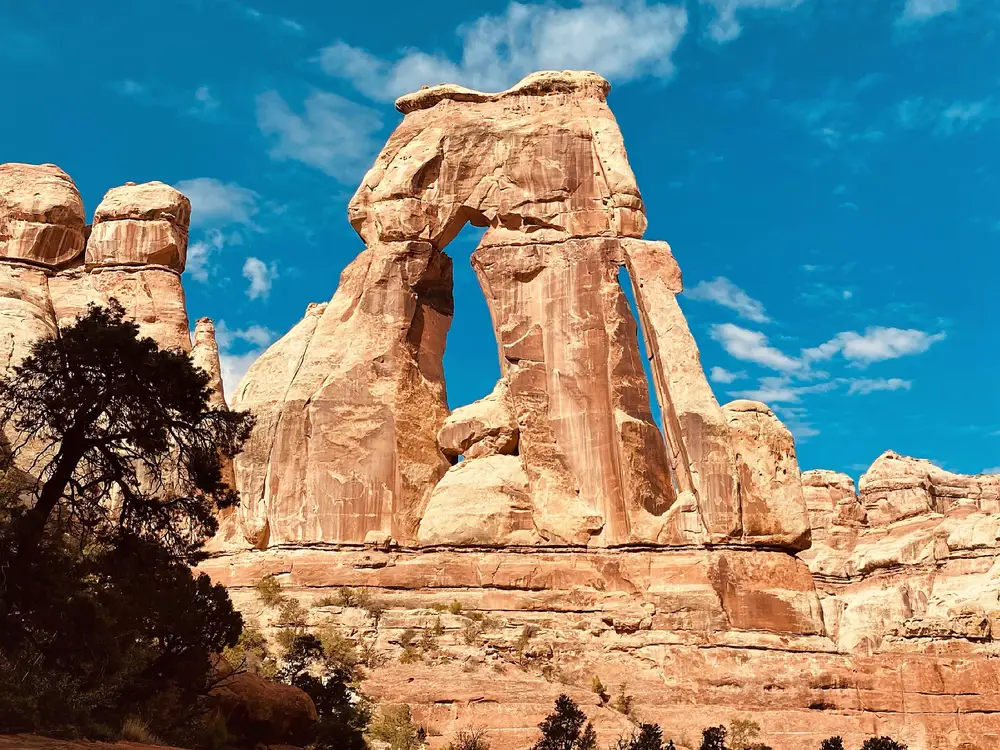
The main hike is the Chesler Park trail, and the choice is between the viewpoint and the full loop, with the winter answer usually being the viewpoint. From the Elephant Hill trailhead, the Chesler Park Viewpoint trail runs 5.8 miles round trip in three to four hours, across open slickrock with cairns marking the route, and the viewpoint gives the classic panorama of the Needles spires and the grassy basin of Chesler Park itself. The full Chesler Park and Joint Trail loop runs 10.7 miles in five to seven hours, and the Joint Trail section, a narrow slot through towering rock fins, is the most memorable part of the Needles, but it is also the part most likely to hold snow and ice in the shade. Turn back at the viewpoint if the Joint Trail looks icy, because the loop is long, the daylight is short, and there is no water on the trail and no ranger station open to help. Druid Arch is the other long objective, a 10.8 mile round trip in five to seven hours along the bottom of Elephant Canyon through deep sand and loose rock, with the last quarter mile steep, with one ladder and some scrambling, and the Park Service trail page warns directly that in winter there may be snow or icy conditions and recommends traction devices for hikers. Choose one long hike, not two, start early, carry more water than seems necessary, and turn back if the Joint Trail or the Druid Arch ladder is iced beyond what the traction aids can hold. Confluence Overlook is the quieter long walk, an 11 mile round trip in five to six hours to a cliff overlooking the junction of the Green and Colorado rivers 1,000 feet below, but the road to its trailhead was closed at the last NPS road update in November 2026 because of damage from recent rains, so confirm both the road and the trail before planning around it. Elephant Hill is not a winter shortcut for anyone without the right vehicle, because the Park Service calls it one of the most technical four-wheel-drive roads in Utah, it needs a high-clearance, low-range four-wheel-drive vehicle and an experienced driver, every vehicle needs a day-use permit, and all-wheel-drive vehicles, ATVs, UTVs, and OHVs are not permitted even when street-legal. Our one day in the Needles guide covers the district in a timed plan, and the winter version of that plan is the same shape with shorter hiking hours and a water supply carried in from town.
The Maze: The Honest Version for Winter
The Maze is the third district of Canyonlands, and it is the one most visitors should not attempt in winter. It is the most remote district in the park, reached by long dirt roads from Highway 24, with no paved access, no water, no gas, and no services of any kind, and the trails there are steep, unmarked, and minimally maintained. A winter trip to the Maze needs a properly equipped high-clearance four-wheel-drive vehicle, a driver experienced in desert backcountry driving, a full water and fuel supply, and a forecast with no storms in it, and even then the trip should be planned as a multi-day expedition, not a day trip from Moab.
The roads into the Maze were in poor shape at the last NPS road update in November 2026, with deep ruts, cutbanks, mud, and standing water on the routes from Highway 24 to Hans Flat and Horseshoe Canyon, and high-clearance four-wheel drive was recommended throughout, with the Flint Trail open and passable but muddy. Towing a disabled vehicle out of the Maze backcountry can cost more than $2,000, and park rangers do not winch vehicles out, so a winter Maze trip that goes wrong becomes expensive before it becomes dangerous. There is one honest exception for a first-time visitor, and it is Horseshoe Canyon, a separate unit reached by a dirt road off Highway 24, where a 7 mile round trip in four to five hours descends 780 feet to view pictograph and petroglyph sites including the Great Gallery, one of the finest rock art sites in North America. Even Horseshoe Canyon needs a high-clearance four-wheel-drive vehicle for its access road, which was listed as needing high-clearance four-wheel drive with deep ruts and mud in November 2026, so check the live road page and leave the Maze for a dry season unless the vehicle, the experience, and the forecast all line up.
Photography, Sunrise, and Sunset in Winter
Winter light is the quiet reason photographers return to Canyonlands in the cold months, and the season gives the mesa top a quality of light that summer never manages. The sun stays low all day, so the canyon layers glow warm from sunrise to sunset instead of washing out at noon, and the long shadows give the fins, spires, and benches a depth that summer light flattens. Mesa Arch photographs best in the early morning for the reflected glow, Grand View Point photographs best in the late afternoon, and Green River Overlook, which faces west, is the classic sunset stop. A dusting of snow on the mesa top outlines every crack and ledge, and the contrast between white snow and red rock is the strongest color combination the desert offers, but the shaded slopes hold their snow for days while sunlit rock melts fast, so the best snow photographs come the morning after a storm. Keep camera batteries warm inside a jacket pocket, because cold drains them fast, and wear traction aids for the short walk from the car to a viewpoint, because the ground there can be a sheet of packed ice. Canyonlands in winter rewards the photographer who stays for both ends of the day, because the low sun does its best work when most visitors have already left for Moab.
After Dark: Long Nights and Dark Skies
Canyonlands is a Gold Tier International Dark Sky Park, designated in 2015, the highest rating the International Dark-Sky Association gives, and the park’s own lightscape guidance says the night sky here is one of the darkest and clearest in the country. The winter sky helps in two ways, because the long nights give more hours of darkness than any other season, and the cold, dry air holds less haze than the summer air. The best stargazing needs no equipment at all, just a clear sky, a dark spot away from the headlights of the scenic drive, and warm clothing, because the park is open 24 hours a day and the overlook parking areas make natural observing spots. The winter constellations, including Orion and Taurus, ride high in the southern sky, and the Geminid meteor shower, which peaks around 13 and 14 December, is one of the best showers of the year, with the Quadrantids following in early January.
One honest note belongs here, because it saves disappointment on a cold night. The bright Milky Way core that fills summer photographs is not visible in November, December, or January, because the core sits below the horizon in the winter months, so winter stargazing is about the sharp winter stars, the planets, and the meteors, not the galactic core. No night-sky photograph is used in this guide, because no freely licensed winter night-sky photograph of the park was verified for this article, and the text says plainly that the core is not visible in winter rather than implying otherwise with a summer image. Bring a red flashlight to protect night vision, dress for ten degrees colder than the thermometer says, and let the eyes adjust for twenty minutes before judging the sky. Our Utah dark sky guide covers the best stargazing nights across all five parks, and Canyonlands is one of the two best parks on that list.
Moab in Winter: Where to Stay and Eat
Moab is the base for almost every winter trip to Canyonlands, and winter changes the town in the visitor’s favor. The town sits about 32 miles and 40 minutes from the Island in the Sky visitor center, and about 75 miles and roughly an hour and a half from the Needles, and it holds the hotels, restaurants, gas stations, and grocery stores that the park itself does not have. Winter is the quietest and cheapest season to book a room, and the restaurants that stay open serve without a wait, though some restaurants and businesses keep shorter winter hours, and a few close for weeks in January and February, so check opening times before counting on a specific place. The honest advice for winter lodging is to book a proper heated room rather than treating the trip as a camping adventure by default, because the park has no lodge inside its boundary, so there is no warm building to retreat to after a cold hiking day except the visitor center, which closes at four in the afternoon. No food, gas, or lodging is sold inside the park, so plan every meal and every fuel stop in Moab, and the winter rates soften the numbers in our Utah Mighty 5 trip cost breakdown.
Camping is the cheapest winter option and the coldest one, and it suits visitors who arrive prepared for it rather than visitors who discover the cold at midnight. Both developed campgrounds are open year-round, and in winter both run first-come, first-served, because the Needles reservation window for Loop B runs only from mid-March to mid-November, so winter campers take whatever site is open on arrival. Willow Flat Campground at Island in the Sky has 12 sites at $15 a night, with vault toilets, picnic tables, and fire rings, and no water at all, while the Needles Campground has 26 individual sites at $20 a night, with toilets, picnic tables, and fire rings, and the winter water position at the Needles campground must be checked against the Park Service winter page, which says there is no water at the campground in winter. Nighttime lows sit in the low 20s on the almanac averages and can drop to zero or below on the coldest nights, so winter camping needs a proper cold-weather sleeping setup, an insulating sleeping pad, and a tent that handles wind, and neither campground has showers or hookups. Dead Horse Point State Park, on the same Utah 313 road as Island in the Sky, makes a useful sunset add-on for a mesa-top day, with its own $20 vehicle fee, as our Dead Horse Point guide explains.
Planning Your Visit: Fees, Timed Entry, and Safety
The planning for canyonlands in winter is simpler than for most national parks in one way, because there is no timed-entry reservation and no shuttle to book, and harder in another way, because the visitor is on their own for water, information, and help. There is no timed-entry reservation system at Canyonlands, and no reservation is needed to enter the park or to drive the scenic roads, though backcountry permits are still required for overnight trips and for driving the White Rim Road, Elephant Hill, Lavender Canyon, and the Peekaboo and Horse Canyon roads. Day-use permits for those roads can be reserved online through Recreation.gov, and overnight backcountry permits can be reserved no more than four months and no less than two days ahead through the park permit site, so a winter overnight trip needs the permit sorted before leaving town, because the Needles visitor center will be closed to issue one in person.
The entrance fee is $30 per private vehicle, $25 per motorcycle, and $15 per person on foot or bicycle for visitors aged 16 and over, and the pass is valid for seven days and covers all three districts. Visitors aged 15 and under enter free, the $55 annual pass covers Arches and Canyonlands plus Natural Bridges and Hovenweep for a year for US citizens and residents, and the America the Beautiful pass is accepted, at $80 a year for US residents and $250 a year for nonresidents, with the current figures on the NPS fees page. Canyonlands does not charge the extra $100 per-person nonresident surcharge that applies at eleven of the busiest parks including Zion and Bryce Canyon, because Canyonlands is not on that list, so international visitors pay the same entrance fee as everyone else at this park. The entrance stations take credit and debit cards only, and the Park Service listed free entrance days for US citizens and residents in 2026, including Presidents Day on 16 February, though the 2027 list had not been published at research time and no 2027 free day should be assumed.
Water and safety planning follows the same rules as the rest of the desert, with a winter twist that makes the cold the hazard visitors forget. Drinking water is available only at a visitor center while it is open, so fill every bottle before hiking, carry at least one quart per person for short trails and up to a gallon for long trails, and carry more than seems necessary in the Needles during the visitor-center closure. Cell service is poor or absent in much of the park, and the Park Service FAQ says visitors may find limited coverage in some areas and no coverage in many areas, and advises not to count on being able to receive service, so download offline maps before leaving Moab and leave a trip plan with someone in town. Flash floods are the one serious danger that winter does not remove, because a storm miles away can send water into a wash with no warning at the trailhead, so never enter a wash or a narrow canyon if rain is forecast anywhere in the region, and never cross a flooded road. Hypothermia deserves a plain mention, because winter visitors associate the desert with heat and forget the cold, and the combination that causes trouble is wind, wet clothing, and a long stop in the shade, with the fix being layers, a windproof shell, and a dry spare layer in the pack.
What to Pack and Wear in Winter
Packing for Canyonlands in winter is a layering problem, not a bulk problem, and the mesa top is the reason why. Start with a moisture-wicking base layer, add an insulating mid-layer, and finish with a windproof and water-resistant outer shell, because the wind on the mesa top cuts through a single jacket faster than the cold air alone. Add a warm hat and gloves, because the extremities lose heat first, and a neck gaiter or buff, because the wind finds every gap. Wear sturdy hiking boots with good ankle support and aggressive tread, because the slickrock is smooth even when it is dry, and the trails are uneven and rocky in places, and add traction aids for every hike, because the Park Service recommends them for snow and ice on the sandstone. Sun protection still matters in winter, because the sun at altitude is strong even on a cold day, and the dry air dehydrates faster than visitors expect, so pack sunscreen, lip balm, and more water than the day seems to need.
Traction aids are the single most important winter item in the pack, and they should be fitted before the icy sections start, not after the first slip, because snow can cover the cairns and the shaded slickrock freezes where the sun never reaches it. Carry at least one quart of water per person for short trails and up to a gallon for long trails, plus snacks, sunscreen, and lip balm, and a headlamp belongs in the pack even for a daytime hike, because the days are short and a slow return can run into dusk. A topographic map belongs in the pack on every Needles hike, because the cairns can disappear under snow and the canyons can look similar without one, and a basic first aid kit and a flashlight belong with it, as the Park Service hiking guidance advises. Our Utah national parks packing list covers the full Mighty 5 kit, and the winter additions here are the traction aids, the windproof shell, and the warm hat and gloves. For the car, the winter kit starts with chains for all four tires, as the Park Service backcountry guidance advises from October through April, plus a full-size spare, extra fuel and water, a shovel, and a high-lift jack for any backcountry driving.
A Practical One-Day Winter Plan for Island in the Sky
One day covers Island in the Sky well in winter, provided the day is planned around the late sunrise, the four o’clock visitor-center closing, and the five o’clock sunset. Leave Moab in time to reach the park for the Mesa Arch sunrise, which means leaving town roughly an hour before the sunrise time for the date, allowing for the 40-minute drive and the short walk in the dark with a headlamp. Spend the first hour at Mesa Arch, then stop at the visitor center when it opens, check the trail-condition information and the road board, fill every water bottle, and use the toilets, because the center is the only water source in the district. Drive the scenic road south with stops at Shafer Canyon Overlook and Green River Overlook, walk the Grand View Point trail in the middle of the day when the light is strongest and the rim is warmest, and add Upheaval Dome or White Rim Overlook in the early afternoon if the footing is dry and the daylight allows it.
Finish the day facing west, because the winter sunset is the reward for the early start. Green River Overlook faces west and makes the natural sunset stop, and Grand View Point takes the last light from every direction at once for visitors who prefer the panorama to the river view. Leave the overlook in good time for the drive back to Moab, because the mesa-top road is unlit, the shaded stretches ice first after sunset, and the drive takes 40 minutes in daylight and longer in the dark. A second day belongs to the Needles, and only on a dry forecast, with water carried in from town, a topographic map, traction aids, and a start early enough to finish the chosen hike well before dark. Our Canyonlands vs Arches guide helps split a Moab stay between the two parks, and our one day in Arches guide covers the park across the road for a second or third day.
Canyonlands in Winter Checklist
- Check the NPS Current Conditions page, the NPS Visiting in Winter page, and the NPS road conditions page before the trip, and check the visitor center board on arrival for road closures and trail conditions.
- Match the trip dates to the visitor-center calendar: Island in the Sky open daily with 9 am to 4 pm hours from 30 November, Needles closed 6 December to 12 February and reopening 13 February 2027, and confirm the Island in the Sky deep-winter weekday pattern on the day, because two Park Service pages differ on it.
- Buy the $30 vehicle pass at the entrance station with a card, or bring the America the Beautiful pass, and remember that Canyonlands charges no $100 nonresident surcharge.
- Pack traction aids for every hiker, three layers plus a windproof shell, waterproof boots, at least one quart of water per person for short trails and up to a gallon for long trails, a headlamp, and a topographic map for the Needles, and keep chains, a spare tire, and extra fuel and water in the car.
- Fill the tank and buy food and water in Moab or Monticello, because there is no food, gas, or lodging inside the park, and fill every bottle again at the Island in the Sky visitor center while it is open.
- Plan the longest hike for the middle of the day, arrive at Mesa Arch 45 to 60 minutes before sunrise, and expect the visitor centers to close at 4 in the afternoon.
- Do not plan a White Rim Road, Shafer Trail, Elephant Hill, or Maze trip in a rental sedan, and reserve any backcountry or day-use permit online at least two days ahead when the visitor center is closed.
- Stay after dark on a clear night for the dark skies, bring a red flashlight, and dress ten degrees warmer than the thermometer says, remembering that the Milky Way core is not visible in the winter months.
- Never enter a wash or a narrow canyon if rain is forecast anywhere in the region, and turn back from any trail that is iced beyond what the traction aids can hold.
Frequently Asked Questions
Is Canyonlands open in winter?
Yes, Canyonlands is generally open year-round, 24 hours a day, including Christmas Day and New Year’s Day, and winter weather does not close the park. What winter closes is the paved roads temporarily after snow while crews plow, the unpaved backcountry roads for longer periods, and the Needles Visitor Center from 6 December through 12 February. The Island in the Sky Visitor Center stays open through the winter, 9 am to 4 pm daily from 30 November through 2 March, except that it closes at 1 pm on Thanksgiving Day and Christmas Eve and is closed all day on Christmas Day.
Do I need a timed-entry reservation for Canyonlands in winter?
No, Canyonlands does not run a timed-entry reservation system, and visitors enter at any time during operating hours with a valid entrance pass. Reservations are a separate matter and still apply to backcountry permits, to day-use permits on the White Rim Road and the Needles four-wheel-drive roads, and to Needles campground sites in their reservable season from mid-March to mid-November. Reserve a backcountry or day-use permit online at least two days ahead when the visitor center is closed, or collect it from the Backcountry Reservation Office in Moab.
How cold does Canyonlands get in winter?
Daytime highs average 45 degrees in December, 44 degrees in January, and 52 degrees in February, and nighttime lows average 23 degrees in December, 22 degrees in January, and 28 degrees in February, on the Park Service weather almanac. December averages 26 days below freezing, January 28 days, and February 22 days, and the Park Service summarises the season more broadly as highs of 30 to 50 degrees and lows of 0 to 20 degrees, with December having dropped to 5 degrees and January to minus 1 degree. The Island in the Sky weather station sits at 5,930 feet, and the wind on the exposed rim makes the cold feel sharper than the thermometer suggests.
Does it snow at Canyonlands in winter?
Yes, but lightly at park level, and the snow that matters most is the snow that stays. Large snowfalls are uncommon in the park itself, except in the nearby mountains, and the Park Service warns that even small amounts of snow or ice can make local trails and roads impassable. The town of Moab averages only about nine inches of snow in a whole year, the snow at park level usually melts within a day or two on sunlit rock, and the La Sal Mountains hold a deep snowpack all winter. After a storm, the paved roads may close for several hours for plowing, the shaded slickrock holds ice for days, and snow can cover the cairns that mark the trails.
Can I hike Mesa Arch and the Needles trails in winter?
Yes, and winter is one of the best times to walk them, with care and with traction aids. Mesa Arch is a 0.6 mile loop in about 30 minutes, it stays open all winter, and the sunrise glow lasts about fifteen minutes, with the winter sun rising to the right of the arch and the slickrock steps liable to ice over. The Needles short trails stay walkable most days, the Chesler Park Viewpoint trail at 5.8 miles is the longest hike most winter visitors should attempt, and the full Chesler Park and Joint Trail loop and the Druid Arch trail at more than ten miles each are for dry days only, with traction aids, a topographic map, and a turnaround rule if the slot or the ladder is iced.
How much is the Canyonlands entrance fee in winter?
The entrance fee is $30 per private vehicle, $25 per motorcycle, and $15 per person on foot or bicycle for visitors aged 16 and over, and the pass is valid for seven days and covers all three districts. Visitors aged 15 and under enter free, and the entrance stations take credit and debit cards only. The fee is the same in winter as in summer, Canyonlands does not charge the extra $100 per-person nonresident surcharge that applies at Zion and Bryce Canyon, and the $55 annual pass covers Arches and Canyonlands plus Natural Bridges and Hovenweep for a year for US citizens and residents, while the America the Beautiful pass costs $80 a year for US residents and $250 a year for nonresidents.
Is the Needles Visitor Center open in winter?
Not for most of the winter, and the dates matter more than the general rule. The Needles Visitor Center is open 8 am to 4 pm daily until 6 December, then closed from 6 December through 12 February, and it reopens on Thursday 13 February 2027, with 8 am to 4 pm hours through 30 March. During the closure there is no water in the district, because water is available only at the visitor center, so bring all the water needed for the visit, and use the pay phone outside the visitor center in an emergency, because rangers remain on duty in the area. The Island in the Sky Visitor Center is the winter fallback, and it stays open daily through the season, subject to the deep-winter weekday question flagged in this guide.
The Bottom Line
Canyonlands in winter is the park without the queue, and the season rewards the visitors who choose the right district and dress for the mesa-top cold. Island in the Sky gives the sunrise, the scenic drive, and the overlooks on paved roads that crews plow, the Needles gives the hiking on the days when the forecast is dry and the water is carried in, and the Maze waits for a dry season and a properly equipped trip. The cold mornings, the short days, the closed Needles visitor center, and the ice on the shaded rock are the price, and the price is fair for a park this vast and this quiet. Check the winter page and the road conditions page before every drive, carry traction aids and more water than seems necessary, and let the quiet do the rest.
Start with our things to do in Canyonlands guide for the full list across all three districts in the busy season. Then read our one day in Island in the Sky guide for the timed mesa-top plan and our one day in the Needles guide for the hiking day, and compare the cold season across the parks with our Arches in winter guide and our Zion in winter guide.